Most founders and small marketing teams hit a wall where they know which keywords to target but lack the hours to actually write, format, and post the articles. You end up with a growing list of to-do content while your organic traffic plateaus because manual production cannot keep up with the speed of search competition.
This guide outlines a functional architecture for moving content from a raw keyword idea to a live, optimized URL without manual intervention. We focus on a Zero-Hire blueprint that bridges the gap between strategy and execution. By building a system where the trigger, the AI writer, and the CMS work in a closed loop, you can maintain a consistent publishing schedule that satisfies both Google and modern AI answer engines like ChatGPT.
You will find a framework for automating the thinking parts of SEO, such as keyword discovery and gap analysis, before the writing even begins. We look at the technical requirements for connecting AI generators directly to platforms like WordPress or Shopify. This approach ensures that every automated post follows strict SEO formatting rules and internal linking structures without requiring a human editor to touch the dashboard.
Use this article to evaluate whether an all-in-one autonomous engine like Tydal or a custom-built stack of individual tools fits your current growth stage. You can skim the sections on technical pipelines if you already have a CMS connection, or focus on the strategy automation section if you struggle with finding the right topics to cover.
The Manual Content Bottleneck: Why Startups Struggle to Scale
Many startups begin their SEO journey with a spreadsheet full of promising keywords. The distance between that list and a published, ranking article is where most growth engines stall. This execution gap exists because manual content production requires a high level of consistent effort that small teams cannot sustain. A single high-quality post often demands four to six hours of research, drafting, image sourcing, and technical SEO formatting. For a founder or a small marketing team, finding twenty hours a week to maintain a basic publishing schedule is often impossible.
The hidden costs of traditional content creation go beyond time. Hiring a dedicated content team or a specialized agency can easily cost thousands of dollars per month, a price point that is out of reach for many early-stage businesses. When the budget is not there, the responsibility falls back on the leadership. This leads to content stagnation, where the company blog remains empty for months because the person in charge is focused on product development or sales.
There is also the frustration of manual SEO formatting. Ensuring every post has the correct header structure, meta descriptions, and internal links is tedious work. In the current search environment, you must also consider how AI platforms like ChatGPT parse your data. If the manual process is already failing to keep up with Google, it will not scale to meet the requirements of Generative Engine Optimization (GEO). Without a system for setting up automated content publication, startups remain trapped in a cycle of sporadic updates that never gain enough momentum to drive significant organic traffic.
The 'Zero-Hire' Blueprint: A Framework for Autonomous Growth
Startups often get stuck in a cycle of buying fragmented tools for keyword research, writing, and scheduling, yet they still spend hours manually moving data between them. A zero-hire content engine replaces this manual plumbing with a unified system that handles both the strategy and the execution. This framework moves away from human-led SOPs (Standard Operating Procedures) toward autonomous engines that require no additional headcount to maintain.
The core of this blueprint follows a linear path: Trigger -> AI -> CMS.
- The Trigger: This is the strategic brain of the operation. In a manual setup, a human finds a keyword and creates a brief. In an autonomous framework, the trigger is an automated keyword discovery process that identifies high-intent, low-competition terms based on live search data.
- The AI: Once a keyword is identified, the system moves to content generation. This stage must do more than just write text; it needs to perform automated SEO formatting, internal linking, and metadata creation. The goal is to produce an article that is ready for both Google crawlers and AI answer engines like ChatGPT.
- The CMS: The final stage is direct publication. The system pushes the formatted content directly to platforms like WordPress or Shopify. This eliminates the copy-pasting bottleneck that often kills content consistency.
By focusing on this three-part architecture, small businesses can maintain a publishing schedule that matches the output of a full content team. This shift allows founders to focus on product and sales while the organic traffic engine runs in the background. Transitioning to an autonomous model ensures that SEO growth is a constant, predictable process rather than a sporadic task performed only when time permits.
Step 1: Automating Keyword Discovery and SEO Strategy
Setting up automated content publication begins with the strategy phase. Most failures in automation happen because users treat AI as a typewriter rather than a strategist. To build a sustainable engine, you must automate the discovery of high-intent, low-competition keywords before a single word is written.
Automated keyword discovery involves using tools that can scan your niche, identify what your competitors are missing, and flag content gaps. This process removes the manual labor of sifting through spreadsheets. You want a system that identifies clusters of related topics so your site builds topical authority automatically. This is a shift from tools to systems that handle both the strategy and the execution.
A zero-hire approach requires this strategy layer to be autonomous. Rather than a human analyst picking a keyword every Monday, the system should generate a queue of targets based on real-time search trends. This ensures your content remains relevant to both Google and AI search engines like ChatGPT.
When selecting your stack, look for tools that connect this research directly to the content generation trigger. For example, Tydal functions as an autonomous SEO growth engine by handling the entire lifecycle, starting with automated keyword planning. This prevents the execution gap where a list of keywords sits unused because no one has the time to turn them into briefs.
By automating the thinking part of SEO, you ensure that every published article has a mathematical reason to exist. This foundation allows the rest of your pipeline to run without constant oversight or manual intervention. Focus on systems that require zero additional headcount to maintain the strategy as search trends shift.
Step 2: Building the AI-to-CMS Pipeline
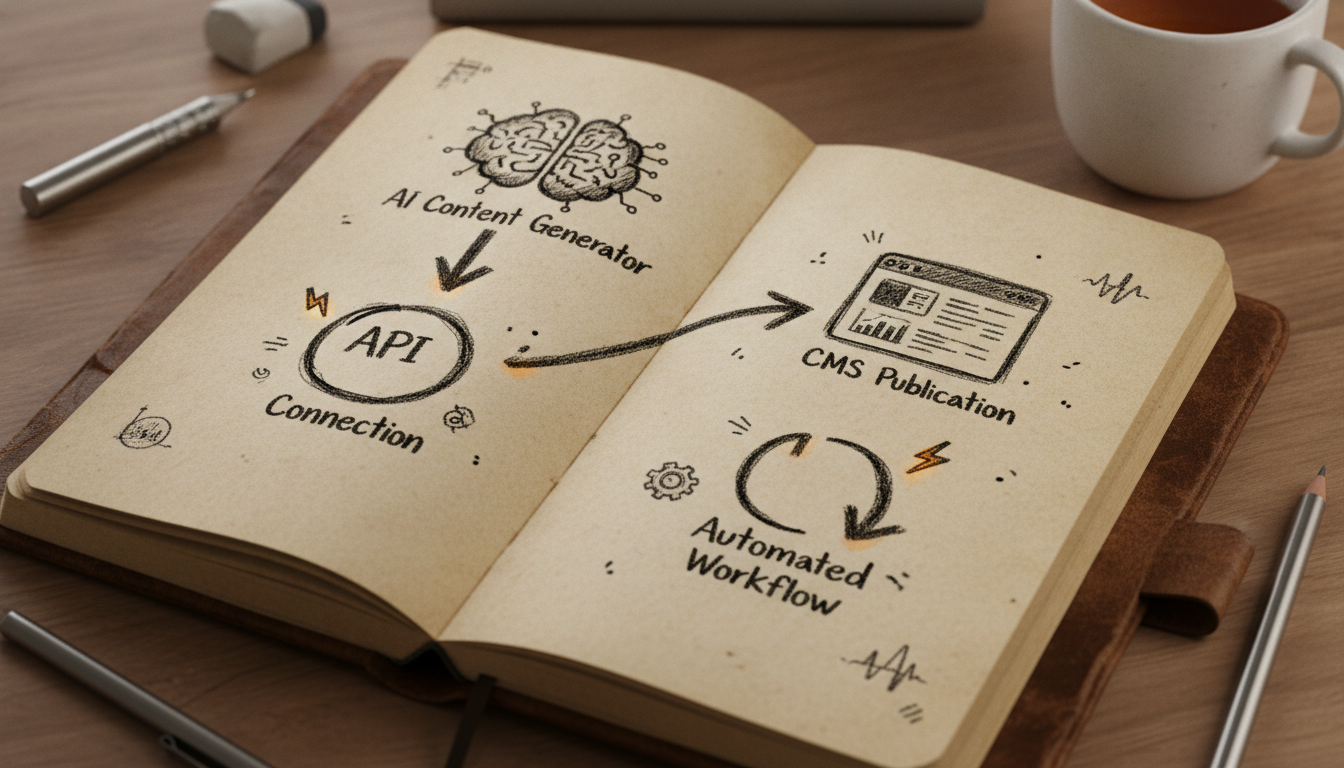
Moving a draft from an AI generator to a live URL is the stage where most automation workflows break. To solve this, you must establish a reliable bridge between your content engine and your Content Management System (CMS), such as WordPress or Shopify. This connection ensures that your content is not only published but also correctly formatted for search engine crawlers without human intervention.
Choosing Your Connection Method
You generally have two paths for building this pipeline: direct native integrations or middleware platforms.
- Direct Integrations: Some autonomous engines, like Tydal, offer native connections to WordPress and Shopify. This is the most efficient path for startups because it eliminates the need for complex "plumbing." The system handles the mapping of titles, body text, and images directly to your site's database.
- Middleware (Zapier or Make): If you use a custom or less common CMS, middleware like Zapier can connect your AI writer to your site. Zapier supports over 9,000 applications, allowing you to create a "Zap" that triggers whenever a new article is generated. However, this often requires manual configuration of data fields to ensure the AI's output lands in the right place.
Automating SEO Formatting and Metadata
A functional pipeline must do more than just paste text. It needs to handle the technical SEO elements that help your content rank on Google and AI answer engines.
- Meta Tags: Ensure your workflow automatically generates and maps the meta title and meta description to the appropriate CMS fields. These should be based on the primary keyword identified in your strategy phase.
- Header Hierarchy: Your pipeline should preserve H1, H2, and H3 tags. Search engines use these to understand the structure of your page, so the automation must maintain HTML formatting during the transfer.
- Internal Linking: Advanced systems can automatically insert links to other relevant pages on your site. This builds site authority and helps crawlers discover new content.
Setting the Publication Status
When setting up the pipeline, you must decide if content should go live immediately or be saved as a draft. For high-volume engines designed for autonomous growth, direct publication is the goal. This allows the system to scale your organic traffic 24/7. If you are just starting, you might set the status to "Draft" for the first five articles to verify that the formatting and SEO metadata are appearing correctly in your CMS editor.
"Connecting your generator directly to your CMS stops the copy-paste cycle that kills most small marketing teams."
Optimizing for the Future: AI Search Visibility (GEO)
The search landscape has shifted toward AI Answer Engines like ChatGPT and Perplexity. Traditional SEO, which focuses on ranking in a list of links, is no longer the sole metric for success. In 2026, businesses must prioritize Generative Engine Optimization (GEO) to ensure their content is selected as a primary source for AI-generated responses.
AI engines do not browse the web like humans. They ingest data to build a context window. To get your content recommended by ChatGPT, you must provide high-density information that is easy for a machine to verify. This involves using structured data, clear semantic hierarchies, and authoritative citations within your articles. When setting up automated content publication, the system should prioritize these technical elements as much as the prose itself.
Structuring content for AI search visibility requires a shift in formatting. AI models favor direct answers and bulleted lists that summarize complex topics. They look for expert signals such as unique data points or specific case studies. If your automated workflow produces generic fluff, AI engines will likely ignore it in favor of more detailed sources. You should ensure your automation engine is configured to output content that satisfies the specific parsing requirements of Large Language Models (LLMs).
Monitoring your visibility on these platforms is now a core part of the SEO process. You need to track how often your brand is cited in AI responses compared to your competitors. Tydal addresses this shift by including AI Search Visibility tracking, allowing users to monitor their rankings on platforms like ChatGPT. This data helps you refine your automated strategy, ensuring your content remains relevant as search behavior evolves from clicking links to asking questions.
Essential Tools for Your Automation Stack
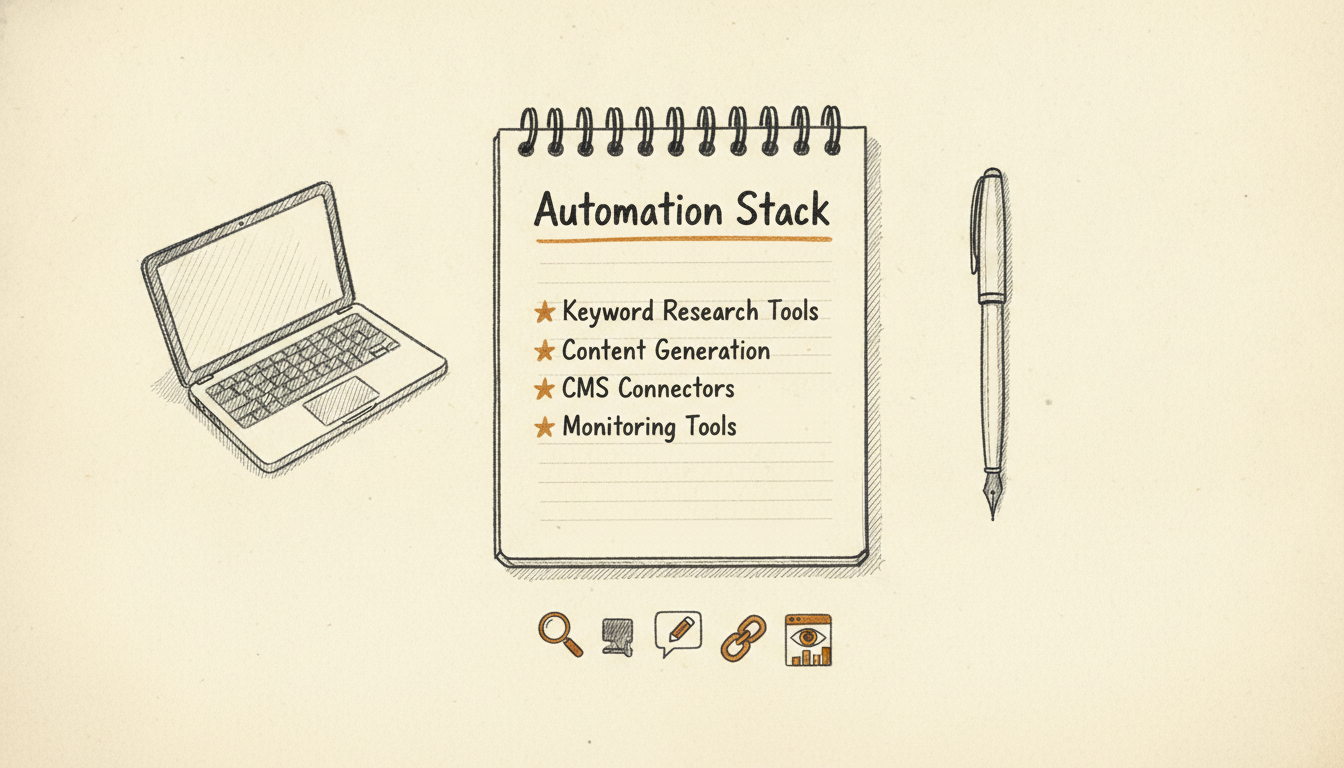
Choosing the right infrastructure for setting up automated content publication depends on whether you want to manage a complex web of tools or deploy a single autonomous system. For most startups and small businesses, the goal is to eliminate the need for a dedicated content team while maintaining high SEO standards.
The Autonomous Growth Engine: Tydal
Tydal is designed as a zero-hire solution for businesses that need to scale organic traffic without manual oversight. It functions as an all-in-one engine that handles the entire content lifecycle. The system begins with automated keyword research to identify high-intent opportunities, moves through AI-driven content generation optimized for search engines, and finishes with direct publication to WordPress or Shopify.
A distinct advantage of this approach is the focus on AI Search Visibility. Tydal tracks how content performs on AI platforms like ChatGPT, ensuring your brand is recommended by generative engines alongside traditional search results. This consolidation reduces the execution gap where strategy and publication often become disconnected in multi-tool setups. Startups can utilize a 3-day free trial to test how the autonomous engine handles their specific niche.
The Modular Middleware: Zapier
Zapier remains the standard for businesses that require highly specific or custom marketing workflows. With access to over 9,000 applications, it allows you to build custom plumbing between your preferred AI models and CMS. Using Zapier Central or the Model Context Protocol (MCP), you can create advanced AI agent interactions that trigger based on complex logic across your existing tech stack.
The trade-off with a modular approach is the manual configuration required. You must define the SEO strategy, select the keywords, and manage the prompt engineering yourself. While Zapier offers immense flexibility, it can become expensive at high volumes due to task-based pricing and requires more hands-on maintenance to ensure the workflows remain functional as third-party APIs update.
Consolidation vs. Fragmentation
Consolidating your stack into a single engine like Tydal often proves more cost-effective for teams without in-house SEO expertise. It removes the friction of managing multiple subscriptions, API keys, and prompt libraries. A fragmented stack is better suited for organizations with established SOPs that need to connect legacy tools into a custom automated pipeline. For those starting from scratch, an autonomous system provides a faster path to ranking on Google and AI platforms without the overhead of a large content department.
Monitoring Success Without Manual Audits
Setting up automated content publication is only half the battle. Without a systematic way to measure performance, you risk scaling a strategy that might not be resonating with search engines or AI models. Traditional manual audits are too slow for an autonomous engine, so your monitoring must be as automated as your production.
The first layer of monitoring involves tracking organic traffic growth and keyword rankings. You can use tools like Google Search Console or Ahrefs to set up automated email alerts or dashboard views that highlight which pages are gaining traction. For a zero-hire setup, you want to see a steady upward trend in impressions and clicks without needing to log in and filter data every morning.
The second layer is AI Search Visibility. As search evolves, you need to know if your content is being used as a source by AI Answer Engines like ChatGPT or Perplexity. This is often called Generative Engine Optimization (GEO). Tydal provides specific tracking for this, allowing you to see how often your brand is recommended in AI-generated responses. This metric is a leading indicator of authority in a post-search world.
Finally, implement a data refresh hub to maintain the relevance of your published articles. Automated content can decay if the facts or trends it references become outdated. Ahrefs suggests building a system where AI agents or scripts periodically check your published URLs against new data points. If a top 10 list from last year is still ranking, the system should trigger a refresh to keep that position.
Key Metrics for Automated SEO:
- Organic CTR: Are the automated titles actually winning the click?
- AI Recommendation Frequency: Is your content being cited by LLMs?
- Ranking Velocity: How fast are new automated posts moving from page 10 to page 1?
- Content Freshness Score: When was the last time the automation engine updated the evergreen stats?
Common Pitfalls and Quality Control
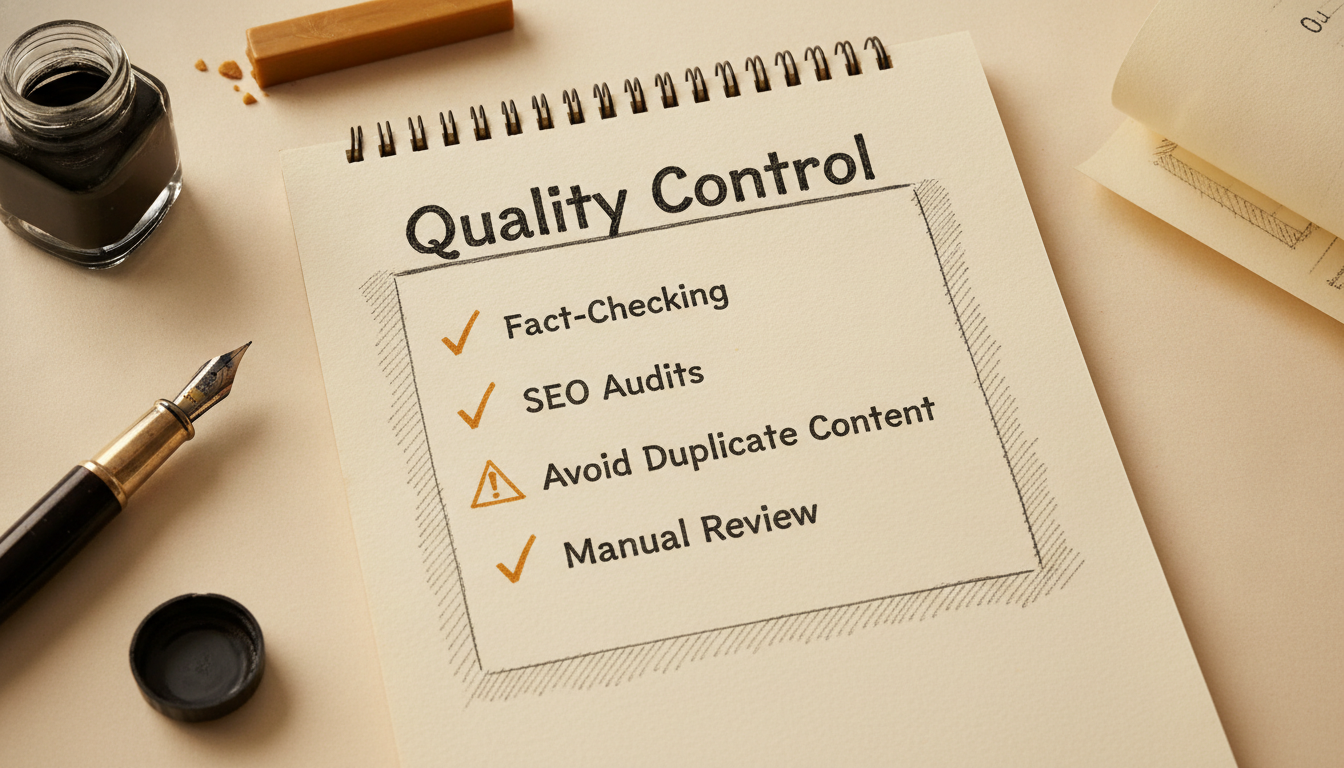
Setting up automated content publication provides a massive efficiency boost, but treating it as a completely hands-off process often leads to diminishing returns. Search engines and AI answer engines prioritize helpfulness. If your system produces high volumes of generic text that fails to answer specific user intent, your rankings will eventually stall.
The "Set and Forget" Risk
The most frequent mistake is failing to audit the output. Automated workflows can occasionally produce factual errors or include outdated information. Even the most advanced autonomous engines require a baseline of periodic oversight to ensure the brand voice remains consistent. I recommend scheduling a monthly review of your top-performing automated pages to verify that links are active and the data remains accurate.
Avoiding SEO Fluff
Google does not penalize AI-generated content specifically, but it does penalize content that lacks original value. If your automation only rehashes existing search results without adding a unique perspective or clear utility, it falls into the category of "SEO fluff." High-quality automation focuses on the strategy behind the keyword. Tools like Tydal help mitigate this by automating the research phase, ensuring the content targets high-intent gaps rather than just high-volume noise.
Strategy vs. Text Generation
Many startups make the mistake of using generic AI writers that lack SEO context. A tool that generates text is not the same as a tool that understands search architecture. Effective automation must handle internal linking, meta-data, and formatting for both Google and AI platforms like ChatGPT. Without this structural intelligence, your content might exist on the web but remain invisible to the algorithms that drive traffic.
When Not to Automate
Automation is ideal for top-of-funnel informational content and SEO-driven growth. However, it is rarely the right choice for deeply personal thought leadership, sensitive legal advice, or highly technical product documentation that requires proprietary internal knowledge. Use automated systems to build your organic foundation, but keep a human in the loop for your most critical brand-defining pieces.
Frequently Asked Questions
How do I start setting up automated content publication?
You begin by selecting a trigger, such as a new keyword discovery or a scheduled calendar event, and connecting it to an AI generation tool. This workflow then pushes the formatted content directly to your CMS like WordPress or Shopify. Using an all-in-one platform can simplify this by handling the strategy and publication in a single loop.
Can automated content publication hurt my SEO rankings?
Automation does not inherently hurt rankings if the output provides genuine value and follows search engine guidelines. Google prioritizes helpful, original content regardless of whether it was produced by a human or AI. Problems only arise when the system generates low quality fluff that fails to answer user intent.
What tools are needed for an automated SEO content workflow?
A standard stack usually includes a keyword research tool, an AI writing assistant, and a middleware platform like Zapier to connect them to your website. Alternatively, autonomous engines consolidate these steps to reduce technical complexity. The goal is to create a seamless path from data input to a live URL.
How do I automate blog posting for Shopify or WordPress?
You can use native integrations or API connections to send AI generated drafts directly to your site backend. Many businesses use automation platforms to bridge the gap between their writing tools and their CMS. This ensures that meta titles, descriptions, and images are automatically populated without manual entry.
Is there a free trial for automated content publication tools?
Many platforms offer limited free tiers or short trial periods to test their workflows. Tydal, for example, provides a 3 day free trial for users to explore its autonomous SEO features. Always check the specific integration limits before committing to a paid plan.
How does automation help with AI search visibility?
Automated systems can be configured to structure data specifically for LLMs like ChatGPT and Perplexity. By using clear headings and factual data points, your content becomes easier for AI engines to parse and recommend. This process is often called Generative Engine Optimization or GEO.
Building a zero hire content engine allows your business to maintain a consistent search presence without the overhead of a full team. Focus on creating a system that prioritizes SEO strategy alongside text generation to ensure long term organic growth. Regular monitoring will help you refine the automation as search algorithms and AI platforms evolve.