Most startup founders recognize that organic traffic is the only way to escape the rising costs of paid ads, yet the reality of manual keyword research and content drafting usually kills momentum before the first lead arrives. You are likely staring at a spreadsheet of high-value keywords while your actual calendar is filled with product demos and fundraising, leaving your blog a digital ghost town that fails to feed the Google or AI search algorithms.
This guide provides a strategic blueprint to move from zero visibility to a self-sustaining organic growth engine. We will look at how the search landscape has shifted in 2026, where appearing in AI Overviews and ChatGPT citations is as vital as the traditional blue links. You will learn to build a technical foundation that satisfies modern indexing requirements while establishing topical authority that proves your expertise to both human readers and large language models.
We focus on solving the execution bottleneck by integrating autonomous SEO workflows. By shifting the heavy lifting of content creation and publication to automated systems like Tydal, lean teams can maintain the high-frequency output required to rank today. We also explore how to leverage community intent on platforms like Reddit to drive immediate traffic while your long-term search authority builds in the background.
Use this article as a 90-day roadmap for your marketing operations. If you are just launching, start with the technical foundation phase to ensure your site is crawlable. If you already have a site but no traffic, jump to the sections on topic clusters and autonomous execution to bridge the gap between your keyword data and your published pages.
The Execution Gap: Why Traditional Startup SEO Advice Fails
Most startup founders begin their SEO journey by following playbooks designed for established enterprises. These guides suggest conducting deep keyword research, building complex spreadsheets, and hiring a team of writers to produce content. For a lean team, this advice creates an immediate execution gap. You have the data and the strategy, but you lack the hands to turn that data into published pages.
Traditional SEO advice often assumes you are starting with a baseline of domain authority. For a new company, an "SEO at Zero" mindset is required. You are building for search before you have any reputation with Google. In this environment, manual content creation becomes the primary bottleneck. If it takes a founder or a single marketing hire five hours to research, write, and format one article, the math for organic growth does not work.
Lean teams often stack expensive subscriptions like Ahrefs or Surfer SEO, only to realize that a list of 50 keywords is useless if those keywords never become URLs. This is why many startups abandon SEO within three months. They are trying to run a manual race against competitors who have been building authority for a decade. In the 2026 search environment, where AI Overviews appear in 26% of US queries, the speed of publication is vital to capture visibility before competitors saturate the AI citations.
Startups seeking to increase organic traffic without hiring a content team often struggle with this manual workload. Platforms like Tydal address this by automating the content lifecycle, allowing founders to focus on product while the SEO engine handles the transition from keyword to live page. To scale effectively, startups must recognize that SEO is a technical execution problem. Relying on manual editorial processes often leads to stagnation, whereas automated systems can bridge the gap between strategy and a live website.
The 2026 Search Landscape: AI Overviews and GEO
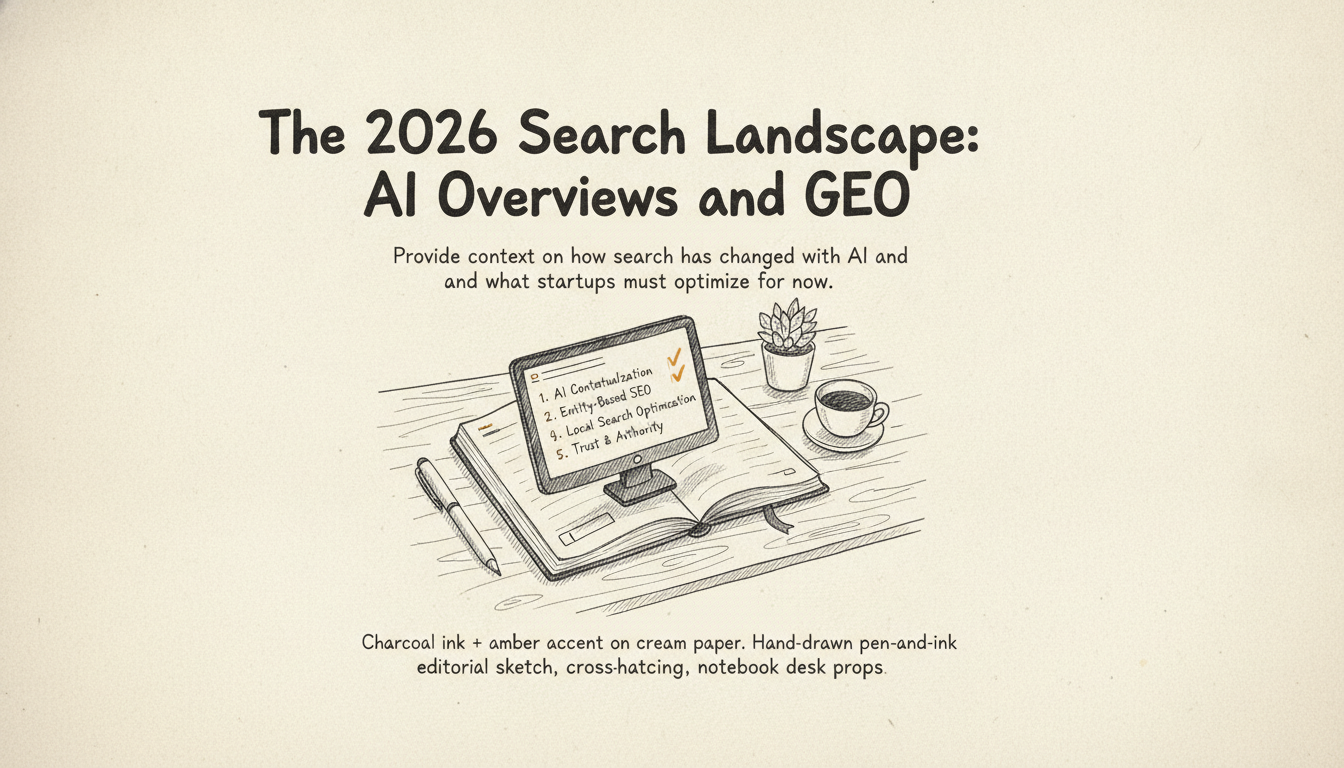
The search environment for startups has undergone a fundamental shift. Google AI Overviews now appear in approximately 26% of US search queries, changing how users interact with results. For a lean startup, this means the traditional goal of ranking blue links is no longer the only objective. You are now competing for a spot within the AI-generated summary itself.
This shift has introduced Generative Engine Optimization (GEO). While traditional SEO focuses on keywords and backlinks, GEO focuses on making your brand citation-worthy for Large Language Models (LLMs). The stakes are high. AI Overviews can reduce click-through rates (CTR) by 15% to 46% for certain queries. If your content merely summarizes common knowledge, the AI will scrape it, display the answer, and the user will never visit your site.
To survive this landscape, startups must produce content that provides unique data, expert opinions, or specific solutions that AI models want to cite as a source. Tools like Ahrefs have adapted to this by introducing AI Adjusted Volume to help marketers estimate actual traffic potential in an LLM-dominated world. Meanwhile, autonomous platforms like Tydal focus on maintaining the high frequency of fresh content that these generative engines prioritize when selecting sources for their overviews. Success in 2026 requires balancing traditional technical health with a strategy that ensures your startup is the primary reference point for the AI answer.
Phase 1: Establishing a Technical Foundation Without a Dev Team
Startups often prioritize product features over site infrastructure, but search engines and AI models require a clean technical entry point to index your brand. You can handle these non-negotiable steps using standard tools without writing custom code.
1. Secure the Connection and Map the Site
Ensure your site uses HTTPS. This encrypted protocol is a standard ranking signal and a prerequisite for trust in the 2026 search environment. Once secured, generate an XML sitemap. Most CMS platforms like WordPress, Webflow, or Framer do this automatically. This file acts as a directory, telling crawlers exactly which pages exist so they do not have to guess your site structure.
2. Optimize for Mobile-First Indexing
Google primarily uses the mobile version of a site's content for indexing and ranking. Test your site on a smartphone to ensure text is legible and interactive elements are not too close together. If your mobile site lacks the content found on your desktop version, you risk losing visibility because the mobile-first crawler will ignore the desktop-only data.
3. Configure Google Search Console for AI Tracking
Google Search Console (GSC) is the most reliable tool for monitoring how your startup appears in search results. Beyond traditional keyword tracking, GSC is the primary source of truth for AI impressions. Following the worldwide rollout of GSC AI Reports on August 31, 2026, founders can see exactly how many times their content was cited in AI Overviews. This data helps you understand if your technical setup allows generative engines to parse your data correctly.
4. Verify Indexing Status
Submit your sitemap directly within GSC to speed up the discovery of new pages. Check the "Indexing" report regularly to identify "Crawled - currently not indexed" errors. For lean teams, fixing these errors is often more productive than building new links, as it ensures the content you have already created is actually eligible to rank.
Phase 2: Building Topic Clusters and the 'Freshness' Pillar
Topical authority is the standard for modern search visibility. Startups must organize their websites into clusters that signal deep expertise to both Google and Large Language Models (LLMs). A topic cluster consists of a central pillar page covering a broad subject and multiple cluster pages that address specific sub-questions. These pages link to each other to create a semantic web that search engines can map. This structure moves your strategy away from keyword-stuffing and toward a model where every piece of content reinforces the authority of the others.
In the 2026 search environment, freshness has evolved into a primary ranking pillar. AI-driven search engines prioritize sources that provide current data and recent updates. A startup blog that has not been updated in three months will lose visibility to competitors who publish weekly, even if the older content is technically accurate. This constant need for new material is where many lean teams struggle. The manual effort required to maintain a high-frequency schedule often leads to burnout or a total halt in production, creating an execution gap that competitors with more resources or better automation can exploit.
Informational clusters must align with sales pages to drive conversions. If a cluster focuses on reducing content creation workload, the internal links should point toward a product page that offers automation solutions. This structure ensures that as informational content gains authority, that relevance flows directly to commercial offerings. It creates a path for the user to move from a general query to a specific solution without leaving your ecosystem.
Effective cluster building requires a shift in mindset. You are building a library of knowledge that proves your startup is the definitive source for a specific problem. This approach satisfies the E-E-A-T requirements that Google uses to evaluate content quality. It makes your site more likely to be cited in AI Overviews, which now appear in 26 percent of US queries. By maintaining a high volume of fresh, interlinked content, you increase the likelihood that LLMs will recommend your brand as a primary source of truth.
Phase 3: Solving the Execution Bottleneck with Autonomous SEO
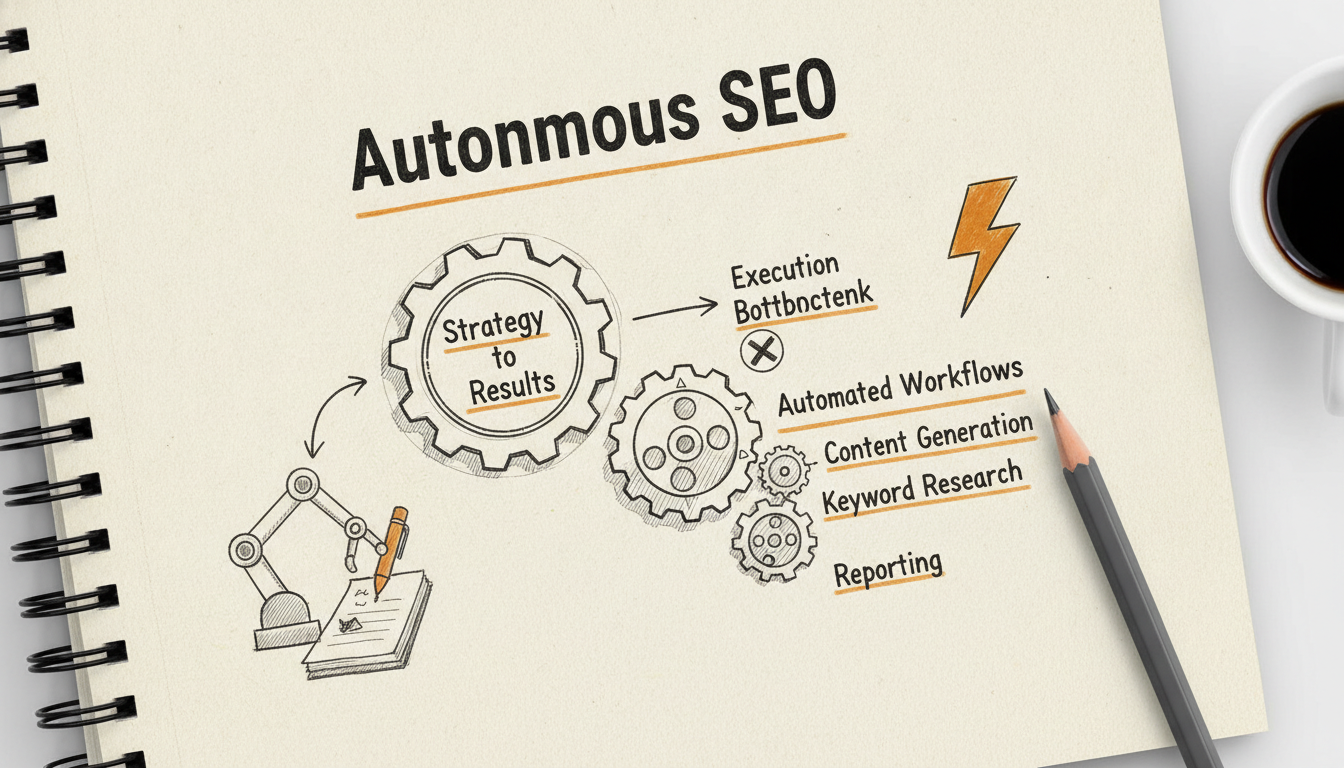
The biggest hurdle for a startup is not finding keywords; it is the actual production of pages. Most lean teams hit a wall where they know what to rank for but cannot afford a $5,000 monthly retainer for a content agency. Autonomous SEO tools bridge this gap by shifting the focus from manual writing to system management.
Platforms like Tydal automate the entire content lifecycle. This system handles keyword planning, writes the articles, and publishes them directly to your CMS. It is designed for founders who need to maintain a high-frequency publishing schedule without hiring a content team. By using an execution engine that works while you sleep, you solve the primary bottleneck of startup growth: the inability to scale output.
For research, Ahrefs remains a standard for competitive data. Their AI Adjusted Volume metric is useful in 2026 because it estimates search demand while accounting for how LLMs and AI Overviews divert traffic. This helps you pick battles where organic clicks still exist.
If you have existing pages that need a boost, Surfer SEO provides a Content Editor that uses Natural Language Processing (NLP) to suggest real-time improvements. It ensures your manual or AI-assisted drafts meet the technical requirements to rank.
| Tool Name | Automation Level | AI Visibility Tracking | Starting Price | Primary Use Case |
|---|---|---|---|---|
| Tydal | Full (Research to Publish) | Yes | $29/month | Startups needing full-cycle SEO automation and Reddit engagement. |
| Ahrefs | Low (Data Only) | Yes | $29/month | Deep competitor analysis and tracking brand visibility in AI search. |
| Surfer SEO | Medium (Optimization) | Yes | $49/month | On-page content optimization and NLP-driven drafting. |
"Startups fail at SEO because they try to do every task manually instead of using tools to handle the repetitive grunt work."
Phase 4: Capturing Intent on Reddit and Community Platforms
Google search results in 2026 prioritize human-first discussions. Reddit and niche forums now frequently appear in Perspectives carousels and serve as the foundation for AI citations in ChatGPT and Perplexity. For a startup, this means your strategy must extend into these communities to capture high-intent users who are actively asking for solutions.
The first step involves identifying intent-rich threads. You should look for solution-seeking queries where users describe a specific pain point your product solves. Manually monitoring dozens of subreddits is impossible for a lean team, so automation is required to bridge this gap.
Platforms like Tydal offer Reddit intent-based discovery to solve this bottleneck. The system scans for relevant conversations in real-time, allowing you to find users at the exact moment they need assistance. Once a thread is identified, the goal is to provide value first. A helpful reply that addresses the user's problem while mentioning your startup can drive direct organic leads and signal to AI models that your brand is a trusted recommendation in that niche.
This community-led approach creates a feedback loop for your traditional SEO. When your brand is discussed on Reddit, it increases the likelihood of being cited in AI Overviews, which currently appear in 26% of US queries. You are building a digital footprint that AI engines recognize as authoritative by participating in the places where your audience actually talks.
To execute this weekly, follow this workflow:
- Identify 5-10 core subreddits where your ideal customers hang out.
- Use automated discovery to surface threads where users ask "How do I..." or "What is the best tool for..." related to your category.
- Respond with helpful advice and a link to a relevant blog post or your homepage when appropriate.
- Monitor your citations in generative engines to see if these community mentions lead to higher visibility in AI-driven answers.
Measuring Success: Tracking AI Visibility and CTR
Traditional rank tracking is no longer the primary indicator of growth for a startup. In the 2026 search environment, where AI Overviews appear in 26% of US queries, a top organic position might still result in minimal traffic if an AI summary satisfies the user intent immediately. You must pivot your reporting toward visibility within generative engines and the specific attribution models provided by search platforms.
The most reliable data comes from the Google Search Console AI Reports, which rolled out on August 31, 2026. These reports provide a breakdown of impressions specifically generated by AI Overviews. Startups should monitor the AI Citation Rate, which is the frequency with which your site is linked as a source within an automated summary. If your impressions are high but your CTR is plummeting, often by 15-46% in AI-heavy niches, your content is likely being used to provide the answer without driving the user to your domain. Use Google Search Console as your primary source of truth for these metrics, as third-party tools still rely on estimation models for AI-driven data.
Beyond Google, you must track your Share of Model (SoM). This metric measures how often generative engines like ChatGPT or Perplexity cite your brand when a user asks a relevant industry question. Ahrefs has introduced AI Adjusted Volume to help estimate demand in this LLM era, while autonomous platforms like Tydal include AI Visibility tracking to monitor how your content is being ingested and cited by these models. This is particularly relevant for lean teams who need to know if their automated publishing schedule is actually building topical authority.
Success is now defined by being the trusted source for the AI. Focus your monthly reporting on three pillars:
- AI Overview Impression Share: The percentage of your target keywords triggering an AI response where you are cited.
- Generative Attribution: Traffic segments in GA4 originating from sources like chatgpt.com or perplexity.ai.
- Citation Depth: The number of unique pages from your domain cited in a single AI response, indicating the strength of your topic clusters.
The 90-Day Startup SEO Roadmap
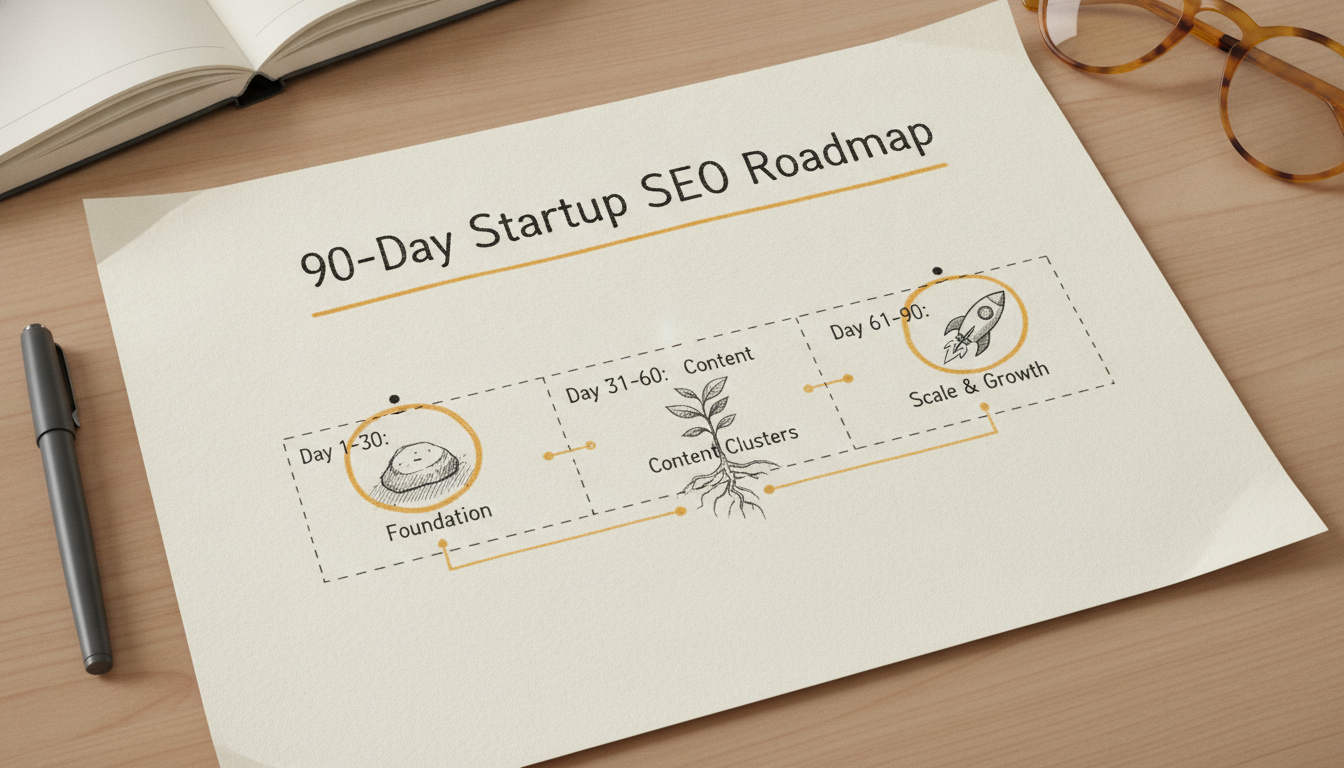
Startups often stall because they treat SEO as a massive, monolithic task. Breaking the first quarter into specific sprints prevents the execution gap where strategy never turns into published pages. This timeline focuses on building a technical base, automating the content bottleneck, and capturing community intent.
Days 1-15: Technical Integrity and Data Streams
Your first two weeks focus on ensuring search engines can crawl your site and that you can see what they are doing. Verify your domain in Google Search Console (GSC) immediately. This is the primary source of truth for tracking impressions in AI Overviews and traditional search results, especially since the rollout of GSC AI Reports in August 2026. Ensure your XML sitemap is submitted and your site uses HTTPS security. If you are starting from a fresh domain, this period is about building authority from a blank slate by ensuring mobile-first indexing is properly configured.
Days 16-45: Intelligence and Automation Setup
Once the plumbing is ready, identify your target clusters. Use tools like Ahrefs to find keywords with high AI Adjusted Volume, which helps you prioritize terms that still drive traffic in an LLM-heavy search environment. Because lean teams rarely have time to write dozens of articles a month manually, this is when you integrate an autonomous system. Platforms like Tydal allow you to map these keywords to an automated content lifecycle, handling the transition from a keyword list to a live, published page on your CMS while you sleep.
Days 46-90: Scaling and Community Signals
The final month is about volume and social proof. Google and AI engines like ChatGPT increasingly prioritize community-driven content and fresh perspectives. Scale your publishing frequency to maintain a high-frequency schedule using your automation workflow. Simultaneously, begin monitoring Reddit and niche forums. You can use Tydal's Reddit automation to find users asking questions related to your product and engage with them naturally. These community signals help validate your brand's relevance to generative engines, increasing the likelihood of being cited in AI-generated answers and driving organic leads from high-intent discussions.
Build vs. Automate: The Cost-Benefit Framework
Founders often face a choice between hiring a dedicated SEO freelancer and leveraging autonomous software. For a startup at SEO Zero, the math is stark. A part-time freelancer typically starts at 1,000 dollars per month for a handful of articles and basic keyword research. In contrast, an autonomous platform like Tydal costs 29 dollars per month. This price gap represents more than just savings; it allows a lean team to allocate capital toward product development or paid acquisition while the SEO engine runs in the background.
The ROI of automation lies in its always-on nature. Manual hires often produce content in bursts, leading to gaps in publishing frequency that can hurt freshness scores in 2026 search environments. Autonomous systems handle the full lifecycle from keyword discovery to direct publication without human intervention. This consistency is vital for building topical authority quickly. While a human writer might take days to research a single Reddit-driven trend, automation identifies intent and generates a response-ready page in minutes.
Transitioning to a human-led content strategy makes sense once the startup reaches a specific scale or operates in a highly technical niche. If your product requires deep, original research or a highly specialized brand voice that AI cannot yet replicate, a manual hire becomes necessary. Most startups should start with automation to build a foundation of traffic and only hire a content team once the organic revenue can justify a 5,000 to 10,000 dollar monthly payroll. Using tools like Tydal allows you to bridge this execution gap during the early stages when speed and cost-efficiency are the primary drivers of survival.
Frequently Asked Questions
What is the best SEO strategy for startups in 2026?
The most effective strategy involves combining a strong technical foundation with Generative Engine Optimization (GEO) to capture visibility in AI search results. Startups should prioritize building topical authority through high-frequency publishing and topic clusters to satisfy both Google and LLMs like ChatGPT.
How much does SEO cost for a startup?
Costs vary significantly, ranging from 29 dollars per month for autonomous software to over 1,000 dollars per month for part-time freelancers. Many lean teams begin with automated platforms to build initial traffic before investing in a full-time content department or agency.
Is SEO still effective for new websites?
Yes, SEO remains a primary driver of organic growth, though the focus has shifted toward creating citation-worthy content for AI Overviews. New websites must establish technical crawlability and use automated workflows to overcome the initial lack of domain authority.
How long does it take for a startup to see SEO results?
Most startups begin seeing measurable traffic growth within 90 days if they maintain a consistent publishing schedule. Using automation to bridge the execution gap can accelerate this timeline by ensuring a steady stream of fresh, optimized content that targets high-intent keywords.
What are the most important SEO tools for lean teams?
Essential tools include Google Search Console for performance tracking and Ahrefs for competitor data. For execution, startups often use platforms like Tydal to automate the creation and publication of SEO-driven articles without needing a dedicated writing team.
How do AI Overviews impact startup search traffic?
AI Overviews appear in approximately 26 percent of US queries and can reduce click-through rates by up to 46 percent. Startups must optimize for Generative Engine Optimization to ensure their brand is cited within these AI-generated summaries to maintain visibility.
Scaling organic traffic requires moving past the manual bottlenecks that stall most early-stage marketing efforts. By combining a solid technical foundation with autonomous content workflows, startups can compete with established players in both traditional search and AI-driven environments. Focus on maintaining a high publishing frequency to build the topical authority necessary for long-term growth.