12 Best Writing AI Tools in 2026 (Tested & Reviewed)
Does your current writing workflow actually result in live traffic, or are you just piling up drafts in a Google Drive folder? In 2026, the bottleneck for most businesses is no longer the ability to generate words. The real challenge is the manual content pile-up, where the time spent researching keywords, editing AI drafts, and manually uploading to a CMS costs more than the software itself. Buyers now need to distinguish between tools that act as simple chat interfaces and those that function as autonomous content systems.
Evaluating writing AI requires looking past the quality of a single paragraph. You must consider the end-to-end lifecycle of a piece of content. A tool that produces beautiful prose but requires three hours of manual SEO optimization and formatting is a productivity trap. The most effective solutions in this category are those that bridge the gap between a raw prompt and a live, ranking asset. This means prioritizing native integrations with your tech stack and the ability to maintain a consistent brand voice without constant human intervention.
The current landscape is divided into three distinct camps. Autonomous SEO engines handle the entire loop from keyword planning to native publication, making them ideal for startups without a content team. Specialized creative studios focus on the nuances of fiction, narrative pacing, or high-conversion ad copy. Finally, generalist assistants offer the highest reasoning capabilities but often require a human to manage the logistics of the publishing process. Each has a specific place depending on whether you are scaling a niche site or managing a global brand.
This guide breaks down the top 12 tools based on their ability to solve these specific production frictions. Use this list to identify where your current process is breaking down. If you are struggling with the manual copy-paste grind, look toward automation-heavy platforms. If your content sounds robotic and fails to engage readers, focus on tools that prioritize natural prose and deep research scaffolding. The goal is to find a solution that fits your existing technical stack and eliminates the need for additional hires.
The Evolution of Writing AI: From Assistants to Autonomous Teams
In 2026, the definition of writing ai has moved past the chat interface. Early versions of these tools required you to sit at a desk, feeding prompts to a bot and copy-pasting results into a CMS. Today, the focus has shifted toward autonomous agents that handle the heavy lifting. These systems do not wait for a manual prompt. They monitor keyword trends, generate drafts, and manage the publishing queue without constant human supervision.
The biggest bottleneck for startups is no longer the writing itself. It is the manual content pile-up. Generating 50 articles is easy, but formatting them, finding images, and hitting publish in WordPress or Shopify takes hours of repetitive work. Modern tools solve this by closing the loop. They act as a complete content team rather than a simple digital pen, moving content directly from the research phase to a live URL.
We are also seeing a transition from traditional SEO to AI Search Optimization (ASO). Ranking on page one of Google still matters, but your content must now be structured so that AI platforms like ChatGPT or Perplexity can parse and recommend it. This requires a specific technical approach to formatting and data density that manual writing often misses. By treating AI as an end-to-end system, businesses can maintain visibility across both traditional search engines and the new generation of AI-driven answer engines.
1. Tydal
Tydal is built for startups and content creators who need to generate organic traffic but cannot justify the expense of a full content team. It manages the heavy lifting of SEO by handling everything from initial keyword planning to the final live publication on your site.
The platform focuses on closing the gap between generating a draft and actually getting it live. By automating the entire loop, it allows users to maintain a consistent content calendar that helps visibility on both Google and AI-driven search platforms like ChatGPT.
Best for End-to-End SEO Automation
This tool fits businesses that find manual content management-keyword research, formatting, and uploading-to be a bottleneck for growth. It is a system designed to run in the background while you focus on product development or sales.
What stands out in actual use:
- Autonomous Workflow: It identifies keywords and produces content without requiring constant manual prompts.
- Native CMS Integration: You can push content directly to WordPress, Shopify, Webflow, Wix, or Ghost.
- Traffic Focus: The output is specifically engineered for ranking and visibility rather than just general prose.
Tydal is not intended for large enterprises that already have established, manual content departments or complex internal review chains. It favors speed and SEO efficiency over the highly granular, multi-layered editing processes found in corporate newsrooms.
It is an autonomous content system that turns SEO from a manual chore into a repeatable, automated process.
Solving the Manual Content Pile-up
Many tools in the writing ai space provide a text editor but leave the user to handle the logistics. This leads to a manual content pile-up where drafts sit in a dashboard because the user lacks the time to copy, paste, and format them into a website. Tydal addresses this by completing the loop. At $99 per month per site, it effectively functions as a junior SEO manager that handles the logistics of getting content from an idea to a live URL.
Native Publishing and Workflow Fit
Where most tools require a third-party connector or manual exports, Tydal uses native integrations to maintain the formatting and metadata required for search engines. This makes it particularly effective for niche sites and growth-stage companies where organic traffic is the primary lead generator. Because it includes a 3-day free trial, you can test the integration with your specific tech stack before committing to the monthly plan.
2. Jasper: Best for Brand-Consistent Marketing Campaigns
Jasper is built for marketing teams and agencies that need to maintain a strict brand identity across multiple channels. It functions as a centralized workspace where you can store style guides and product knowledge to ensure every generated piece sounds like your company. This focus on context makes it a reliable choice for businesses that have moved past simple prompt-based writing and need a more structured environment.
The platform has evolved into a comprehensive marketing engine that uses specialized agents and repeatable pipelines. By integrating your specific brand data, Jasper helps you scale content production without the typical quality drift that occurs when using generic AI models. This setup is particularly useful for teams managing complex, multi-channel campaigns that require a high degree of coordination.
Best for Multi-Channel Brand Consistency
This tool fits teams that prioritize a unified voice above all else. When you are managing social media, email sequences, and blog posts simultaneously, Jasper uses its Knowledge Base to pull from your specific data rather than relying on general training data. This ensures that technical details and brand values remain accurate across every asset produced.
What stands out in actual use:
- Brand Voice and Knowledge Base: You can upload documents or crawl your website to create a digital twin of your brand's tone and factual background.
- Jasper Grid: This feature allows for the creation of repeatable content pipelines, making it easier to turn a single brief into a full multi-asset campaign.
- No-code AI App Builder: Teams can build custom tools for specific internal tasks, such as product description generators or ad copy builders, without needing a developer.
The cost is a significant factor for growing teams, as the Pro plan starts at $59 per seat per month when billed annually. While the writing quality is high, deep SEO optimization requires a separate subscription to Surfer SEO. This adds an extra layer of cost and tool management if your primary goal is ranking on search engines rather than just generating marketing copy.
Jasper remains a premium choice for brand-conscious organizations that need a high-end workspace to manage complex marketing workflows and maintain a consistent voice at scale.
3. Claude (Anthropic): Best for Natural Prose and Complex Research
Claude is the primary choice for writers who prioritize high-end editorial quality and natural flow over raw speed. While many models lean into predictable patterns, Claude excels at maintaining a human-like voice across long-form essays, research papers, and complex narratives. It is built for professional environments where the nuance of the writing matters as much as the information provided.
The tool shines when you need to process massive amounts of information. Its 1M+ token context window means you can upload entire books or technical documentation to extract insights or rewrite sections without losing the thread of the original material. This makes it a powerful research assistant that understands the specific context of your project better than generalist bots.
Best for High-end editorial work and natural prose
This tool fits professional writers and researchers who need a partner for deep reasoning rather than a simple text generator. It is effective for those who find other models too robotic or repetitive for sophisticated B2B content or creative projects that require a light touch.
What stands out in actual use:
- Artifacts: This feature allows you to visualize and edit content in real-time within a side-by-side window, making it easier to iterate on code or long documents without scrolling through a chat history.
- Context Handling: The 1M+ token window enables the model to remember details from thousands of pages of source material, which is a significant advantage for technical whitepapers or complex brand guides.
- Constitutional AI: Anthropic builds the model with a safety framework that results in more reliable and less biased outputs compared to many other writing assistants.
Usage limits on the Pro plan can be a bottleneck for high-volume users. If you are generating dozens of long-form articles daily, you might hit a wall where you have to wait for your quota to reset or upgrade to the Max plan starting at $100 per month. This makes it less ideal for high-speed content mills compared to more automated systems.
Claude remains the gold standard for quality-first creators who value nuance and reasoning over the high-volume automation found in tools like Tydal.
4. ChatGPT (OpenAI): Best for General Tasks and Background Automation
ChatGPT remains the most versatile writing ai for users who need a tool that handles more than simple text generation. In 2026, it functions as a central hub for digital tasks, moving beyond the chat interface into a workspace that manages research, data analysis, and document drafting through the GPT-6 Astra model. This versatility makes it a staple for generalist workflows where speed and task diversity are prioritized over niche specialization.
The primary reason to choose ChatGPT over specialized competitors is its deep integration with the broader productivity ecosystem. It works natively with Microsoft 365 and Apple Intelligence, making it a frictionless option for professionals who want their AI assistant to live inside their existing document and communication stacks. For those managing complex projects, the ability to pull in data from Google Drive or Slack directly into the writing process is a major efficiency gain.
Best for general-purpose writing and background automation
This tool is the standard for individuals and teams who require a high-utility assistant capable of switching from writing a LinkedIn post to analyzing a spreadsheet in seconds.
What stands out in actual use:
- Dots system: These always-on agents allow you to schedule recurring, offline tasks that run in the background without manual prompting.
- Canvas workspace: A dedicated environment for long-form editing that separates the chat history from the actual document you are refining.
- Deep Research mode: A feature that crawls the web to build comprehensive reports before you start the writing process.
A notable drawback involves the prose quality of the GPT-5.x variants, which many users find robotic and repetitive. This requires significant manual oversight when the goal is to produce content that sounds truly human. While the GPT-6 Astra flagship model is more capable, the lower-tier models available in the free Luna version can struggle with narrative flow and nuance.
ChatGPT is the ultimate generalist, providing a massive ecosystem and background automation that makes it a reliable choice for teams needing a versatile tool for their content operations. OpenAI offers several tiers, including a Business plan at 20-25 dollars per seat with a two-seat minimum, and a Pro tier that ranges from 100 to 500 dollars per month for heavy power users.
5. Copy.ai: Best for GTM and Sales Workflow Automation
Copy.ai has shifted from a general-purpose writing assistant to a specialized platform for Go-To-Market (GTM) teams. It targets growth-stage sales and marketing departments that need to automate the repetitive tasks associated with outbound sequences and lead generation. By focusing on sales velocity, the tool helps teams execute high-volume outreach without losing the personalization required for modern B2B sales.
The platform excels at connecting disparate data points into cohesive sales motions. By using AI Workflows and real-time web search, teams can move past simple drafting and into high-velocity execution where the AI handles the heavy lifting of prospect research and message tailoring. This makes it a workflow engine rather than a basic text generator.
Best for Sales Velocity and Outbound Automation
This tool fits teams that prioritize conversion and speed over long-form editorial content. If your goal is to scale personalized outreach across multiple channels without manually researching every prospect, Copy.ai provides the infrastructure to build repeatable pipelines. It is particularly useful for teams that have outgrown manual copy-pasting and need a centralized hub for their GTM operations.
What stands out in actual use:
- AI Workflows: You can build automated sequences that pull data from real-time web searches to personalize emails or LinkedIn messages.
- Multi-model access: The system allows you to leverage different LLMs depending on the specific task, ensuring the right model is used for the right step.
- Brand Voice and Tables: Maintain consistency across a large sales team while managing structured data within the platform through Fullcast integrations.
Users should be aware of the steep pricing cliff. While the Pro plan is accessible at $49 per month for five seats, the jump to the Growth tier is $1,000 per month. Additionally, while it handles short-form sales copy and outbound sequences exceptionally well, the quality of long-form blog content can be inconsistent compared to editorial-focused tools.
Copy.ai is a specialized GTM engine that prioritizes sales velocity, making it a strong choice for teams focused on outbound growth and workflow automation.
6. Sudowrite
Sudowrite is a specialized writing ai built for novelists and creative writers who find general-purpose models too rigid for narrative work. It focuses on the mechanics of storytelling, such as maintaining character consistency and managing plot beats, rather than generating marketing copy or SEO blogs.
The platform operates as a collaborative studio where the AI acts as a developmental editor or a co-writer. It helps authors push through writer's block by offering multiple paths for a scene without stripping away the creator's unique voice.
Best for Fiction Authors and Novelists
This tool fits writers who need help with the heavy lifting of long-form narrative structure. Whether you are drafting a first novel or refining a complex series, the interface is designed to keep your worldbuilding notes and character bibles within reach of the generator.
What stands out in actual use:
- Story Engine: This feature maps out your entire narrative arc, ensuring that the AI follows your specific plot beats and character arcs across chapters.
- Describe Tool: It generates sensory details (sight, sound, smell, taste, touch) to help ground a scene in a way that generalist models often overlook.
- Ownership Rights: You retain 100 percent ownership of everything you create, which is a vital protection for professional authors.
One challenge is the unpredictable credit consumption during long sessions. Since the AI processes large amounts of context to maintain story coherence, it is easy to burn through your monthly allowance while experimenting with different scene directions or using the Brainstorm buddy. You need to monitor your usage closely to avoid running out of credits mid-chapter.
Sudowrite is the clear choice for creative writers who need a dedicated environment for worldbuilding and narrative pacing. It trades broad marketing utility for deep, specialized features that help turn a rough outline into a finished manuscript.
7. Anyword
Anyword targets performance marketers and agencies who need to justify every word of their writing ai output with potential ROI. It prioritizes the likelihood of a click or conversion by analyzing how specific audiences respond to different phrasing. The platform operates as a data-backed editor that scores drafts against historical performance data. This workflow moves the decision-making process away from creative intuition and toward measurable metrics. By integrating directly with ad platforms like Google Ads and Facebook Ads, it allows teams to refine their messaging based on what actually works for their specific brand voice and target demographics. Anyword claims an 82% accuracy rate for its Predictive Performance Score, providing a statistical safety net for high-stakes campaigns where a small difference in click-through rate changes the entire campaign's profitability.
Best for Predictive Ad Performance
Performance marketers often spend hours A/B testing variants that could have been filtered out during the drafting phase. Anyword fits teams that manage substantial ad spend across Google and Facebook and need a way to validate copy before it goes live. It is particularly useful for agencies managing multiple clients who require strict brand voice enforcement alongside measurable performance gains.
What stands out in actual use:
- Predictive Performance Score: This tool estimates ROI and click-through rates before you publish, using a score to rank different copy variations.
- Copy Intelligence Dashboard: You can connect your social and search ad accounts to see which messaging styles are currently winning across your entire funnel.
- Brand Voice Enforcement: The system ensures that even when generating unlimited word counts, the AI adheres to specific vocabulary and tonal guidelines defined by the user.
- Native Integrations: Direct connections with HubSpot and Zapier allow for automated workflows that move high-performing copy into CRM or marketing automation sequences.
The main trade-off involves the scope of the predictive engine. While the scoring is highly effective for short-form PPC ads and landing pages, it is less effective for long-form blogs. The data models are optimized for conversion events rather than the nuanced engagement metrics typically associated with 2,000-word editorial pieces.
Anyword provides a specialized environment where data replaces guesswork. If your primary goal is lowering customer acquisition costs through better ad copy, the $99 per month Data-Driven plan offers a clear path to scaling performance without increasing manual testing time.
8. Writer: Best for Enterprise Compliance and Security
Writer is built for large organizations in regulated sectors like healthcare and finance that cannot risk using standard AI tools that send data to external providers. It focuses on scaling agentic workflows while maintaining strict control over data privacy and factual accuracy. This platform is designed for the high-stakes environment where a single hallucination or data leak could result in legal or financial penalties.
The platform operates on its own proprietary Palmyra LLMs. This gives enterprises a closed-loop environment where they can build custom AI applications without their sensitive data being used to train third-party models. With a recent 200M dollar Series C funding round and a 1.9B dollar valuation, the company has the stability required for long-term enterprise partnerships.
Best for Regulated Industries and Enterprise Security
This tool fits teams that need to automate complex writing tasks while adhering to legal standards like HIPAA or SOC 2 Type II. It is particularly useful for companies that require Retrieval-Augmented Generation (RAG) to ensure the AI only writes based on their specific internal data.
What stands out in actual use:
- Proprietary Palmyra Models: Writer uses its own domain-specific models for better security and output control.
- Knowledge Graph for RAG: The system uses an advanced Knowledge Graph to connect the AI to your internal data, reducing hallucinations and ensuring every claim is backed by your own documentation.
- Enterprise-Grade Compliance: It carries SOC 2 Type II and HIPAA certifications, making it a safe choice for legal, medical, or financial content teams.
- AI HQ: A centralized hub for managing agentic workflows and brand-consistent content across a large workforce.
The entry barrier is high for solo creators or small startups. With pricing starting around 29 to 39 dollars per user and a heavy focus on complex enterprise infrastructure, it is often overkill for those who just need a simple blog post generator. Small teams may find the setup process more involved than the plug-and-play nature of consumer-grade writing AI.
Writer serves as a secure foundation for corporate content strategy rather than a lightweight assistant for casual writing. It is the preferred choice for businesses that prioritize data sovereignty and regulatory compliance above all else.
9. Koala AI
Koala AI is built for niche site owners and SEO professionals who need to turn search engine data into published articles at high speed. It handles the specific requirements of affiliate marketing, such as product reviews and informational blog posts, by pulling real-time data from the web to inform its drafts. This tool is designed to bridge the gap between keyword research and a live URL with as little manual intervention as possible.
The platform focuses on a streamlined workflow that moves from initial concept to a live post with minimal friction. By integrating SERP analysis directly into the writing process, it ensures that the generated content aligns with what is currently ranking on Google. This makes it a practical choice for those who prioritize SEO structure and publication speed over complex editorial workflows.
Best for Rapid Niche Site Content
This tool fits creators managing a portfolio of websites where volume and SEO alignment are the top priorities. It is particularly effective for those running Amazon affiliate sites who need to generate product roundups or informational guides without the manual burden of gathering product specs and formatting links.
What stands out in actual use:
- One-click publishing: Direct integrations with WordPress, Shopify, Webflow, and Ghost allow you to push content live immediately after generation.
- Deep Research mode: The AI scans current search results and cites sources before drafting, which helps maintain factual accuracy in competitive niches.
- Automatic internal linking: It analyzes your site structure to suggest or insert relevant internal links, reducing the time spent on manual on-page optimization.
- Amazon integration: Specifically designed to pull product data for affiliate reviews, making it a specialized choice for e-commerce content creators.
While Koala AI excels at speed and SEO structure, it offers less control over nuanced brand voice than generalist tools like Jasper or Claude. If your strategy relies on a highly specific editorial tone or unique storytelling, you may find the outputs require more manual polishing to feel fully aligned with your brand identity. Pricing is based on credit volume, which can vary depending on your output needs.
Koala AI serves as a high-velocity production engine for SEOs who value a tight feedback loop between research and publication.
10. Surfer SEO: Best for Data-Driven Content Optimization
Surfer SEO is the industry standard for on-page SEO data and keyword density. It helps content teams and agencies bridge the gap between creative writing and technical ranking requirements by providing specific structural recommendations based on real-time SERP analysis. Rather than guessing which terms matter, you get a data-backed roadmap for every article.
The platform focuses on the optimization phase of the writing ai workflow. It provides a Content Editor that scores your draft against competitors, ensuring your article includes the specific terms and topics Google expects to see for a given query. This makes it a primary tool for those who need to ensure their AI-generated drafts actually reach the first page.
Best for SEO agencies and content teams
This tool fits teams that prioritize search visibility and need a repeatable system for content quality control. It is particularly useful for optimizing existing content that has lost its ranking or for drafting new articles with a clear competitive edge.
What stands out in actual use:
- AI Search Optimization (ASO): Focuses on ensuring visibility on platforms like ChatGPT and Perplexity, moving beyond traditional search engines.
- Rank Drop Detection: Alerts you when your content starts losing its position so you can re-optimize before traffic falls off.
- Surfy AI Assistant: Helps generate or refine sections of your text directly within the editor using SEO-informed prompts.
- Native Integrations: Connects with Jasper, Google Docs, and WordPress to eliminate the friction of moving text between windows.
A significant trade-off is that following the data too strictly can lead to formulaic writing. If you focus solely on hitting every keyword target to achieve a high score, the prose can feel repetitive or forced. This requires a human editor to maintain a natural voice while still satisfying the algorithm's requirements.
Surfer SEO functions as a technical powerhouse for those who treat content as a data problem. It is a specialized optimization engine that ensures your articles are competitive enough to survive the scrutiny of modern search algorithms.
11. Blaze AI: Best for Solo Founder Marketing Engines
Blaze AI functions as a central hub for solo founders who need to manage their entire marketing presence without jumping between multiple disconnected tools. It handles the tactical execution of a marketing funnel, from generating initial content to managing the leads that the content eventually attracts.
The platform is built around a Weekly Autopilot rhythm. This structure enforces a consistent cadence on your marketing efforts, ensuring that ad campaigns, social posts, and review requests happen on a set schedule rather than whenever you happen to find a spare hour in your week.
Best for solo founder marketing engines
Blaze AI fits service-based businesses and solo entrepreneurs who want a system that moves beyond simple text generation. It is designed for those who need an automated workflow to maintain visibility on Google and social platforms while qualifying incoming interest through integrated communication tools.
What stands out in actual use:
- AI Receptionist: This feature handles lead qualification, ensuring that the traffic your content generates is actually vetted before it reaches your calendar.
- Funnel Management: It coordinates automated ad campaigns alongside organic posts to create a unified marketing engine from a single dashboard.
- Review Automation: The system automatically triggers review requests, which helps improve local SEO and Google Business Profile rankings without manual follow-up.
The pricing structure presents a steep jump for those wanting the full automation suite. While the Starter plan is accessible at $79 per month, the All-In-One tier reaches $999 per month. This creates a significant gap for micro-businesses that are scaling but have not yet reached the revenue consistency required for the highest tier.
Blaze AI is a comprehensive choice for founders who want to outsource their entire marketing rhythm to a single piece of software rather than managing a fragmented stack of writing assistants.
12. HaloMate: Best for Multi-Model Power Users
HaloMate serves writers who require multiple AI engines to complete complex professional tasks. It provides a unified workspace where you can toggle between models like GPT, Claude, and Gemini without the friction of managing separate subscriptions or browser tabs. This setup is particularly useful for users who find that one model excels at logic while another produces better natural prose.
The core advantage lies in workflow organization and context management. By centralizing different LLMs into a single interface, it allows for direct comparison of outputs and more disciplined research. It is a utility-first platform designed to reduce the mental overhead of switching environments during a high-volume writing session.
Best for Multi-Model Workflows and Professional Comparison
This tool fits professional writers and researchers who need to verify information across different AI architectures or leverage specific model strengths for different parts of a project. It is a strong choice for power users who want to avoid the limitations of a single-brand ecosystem.
What stands out in actual use:
- Mate System: Specialized agents provide context isolation for different projects, which prevents data bleed and keeps individual tasks organized.
- Unified Model Access: You can switch between OpenAI, Anthropic, and Google models within one private workspace.
- AutoPilot Research: This feature automates the initial information gathering phase before you begin the drafting process.
- Secure File Drive: A centralized location to store reference documents that can be accessed by any of the active models.
A clear trade-off is that HaloMate lacks the deep native ecosystem found in standalone platforms like OpenAI or Google. You will not have access to the same level of first-party app integrations or the specialized background automation systems native to those parent platforms.
HaloMate is a specialized utility for writers who value model variety and organized research over a single-brand ecosystem. With pricing tiers starting at $9.9 per month and a free tier offering 1,000 credits per day, it is an accessible entry point for those needing cross-model comparison.
How to Choose: AI Content Team vs. Writing Assistant
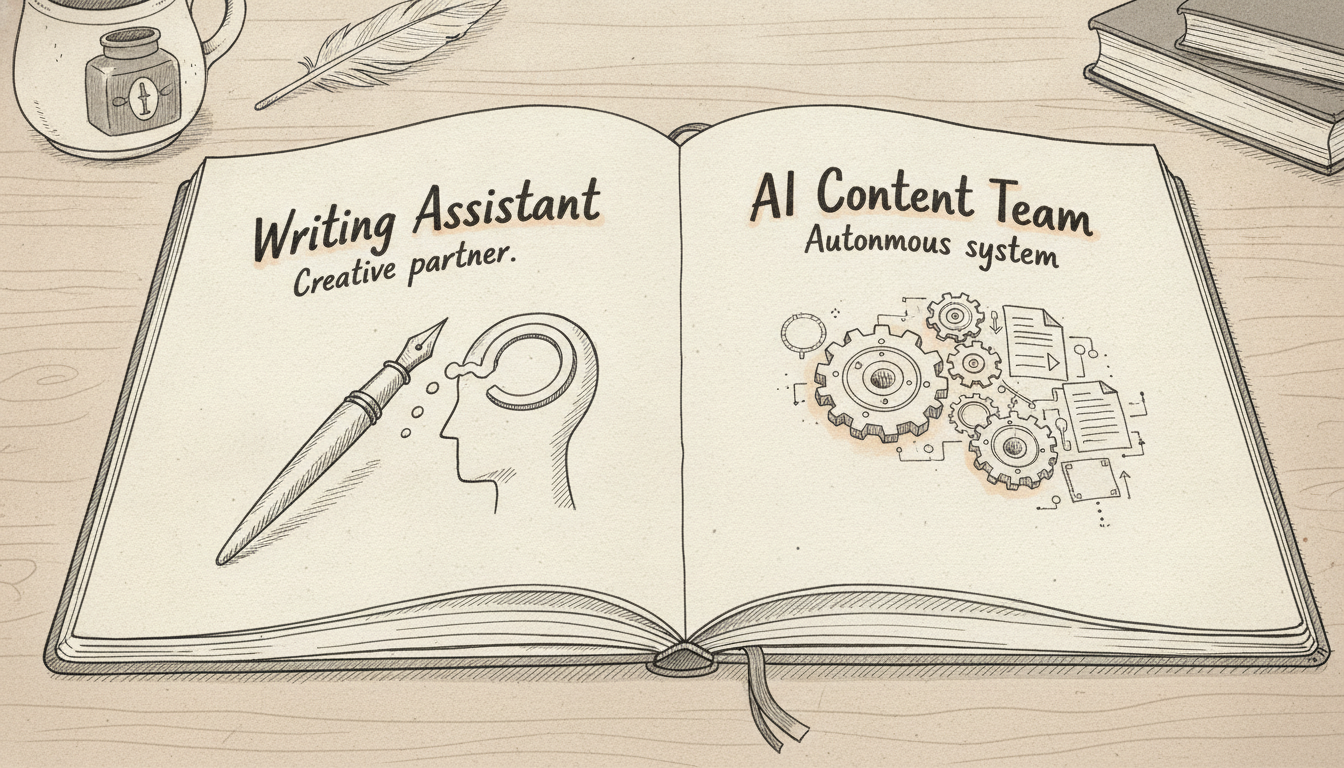
Choosing the best ai writing software requires looking past the quality of the prose to the efficiency of the workflow. Most users start by looking for a tool that writes well, but they quickly realize that generating text is the easiest part of the process. The real friction lies in the "Draft-to-Live" gap.
In a standard manual workflow, writing represents roughly 20 percent of the total effort. The other 80 percent is consumed by keyword research, SEO optimization, finding images, and the repetitive task of formatting and publishing to a CMS like WordPress or Shopify. If you already have a content manager, a writing
Top 12 Writing AI Tools: Features & Pricing Comparison
| Product | Best For | Key Feature | Automation Level | Price |
|---|---|---|---|---|
| Tydal | End-to-end SEO automation for startups and creators | Automated keyword planning and native CMS publishing | High (Autonomous) | $99/month per site |
| Jasper | Brand-consistent marketing campaigns | Brand Voice and Knowledge Base | Medium (Agentic) | $59/seat/month |
| Claude (Anthropic) | High-end editorial work and natural prose | 1M+ token context window | Low (Assistant) | $20/month (Pro) |
| ChatGPT (OpenAI) | General tasks and background automation | Dots (always-on agents) | Medium (Agentic) | $20/month (Plus) |
| Copy.ai | GTM and sales workflow automation | AI Workflows for outbound sequences | Medium (Workflow-based) | $49/month (Pro) |
| Sudowrite | Fiction authors and novelists | Story Engine for narrative structure | Low (Creative assistant) | $10/month (Hobby) |
| Anyword | Performance-driven ad copy | Predictive Performance Score | Low (Predictive) | $49/month (Starter) |
| Writer | Enterprise compliance and security | Proprietary Palmyra LLMs | Medium (Agentic) | $29-39/user/month |
| Koala AI | Rapid niche site content | One-click publishing and internal linking | High (Workflow) | Varies by credit volume |
| Surfer SEO | Data-driven content optimization | AI Search Optimization (ASO) | Low (Optimization) | $49/month (Discovery) |
| Blaze AI | Solo founder marketing engines | AI Receptionist and lead qualification | Medium (Funnel management) | $79/month (Starter) |
| HaloMate | Multi-model power users | Mate context isolation system | Low (Workspace) | $9.9/month (Plus) |
Choose the AI Tool That Removes Your Content Bottleneck
Selecting the right writing AI depends on where your workflow breaks down. If you spend hours agonizing over the perfect sentence for a long-form essay, Claude (Anthropic) provides the most human-like prose and reasoning. For teams in regulated sectors like healthcare or finance, Writer offers a level of security and compliance that generalist tools cannot match. Fiction writers should look toward Sudowrite, as its Story Engine is specifically tuned for narrative pacing rather than marketing ROI.
Many businesses find that the actual writing is only a small part of the problem. The real friction often lies in the research and publishing stages. If you are an affiliate marketer or niche site owner, Koala AI speeds up the transition from draft to live site. For those managing complex brand voices across multiple channels, Jasper provides the necessary guardrails to keep every piece of content consistent with your established identity.
Most startups and creators face a specific challenge: the manual content pile-up. Generating a thousand words is easy, but performing keyword research, formatting the post, and manually uploading it to a CMS like WordPress or Shopify consumes the time you should spend on growth. This gap between drafting and publishing is where most SEO strategies fail. Automating this entire loop can replace the need for a dedicated content team or expensive freelancers.
Tydal is a strong option for those who want to focus on organic traffic without the manual grind. It functions as an autonomous SEO engine that handles keyword planning, content creation, and native publishing in one system. This approach is particularly effective for small businesses that need to scale their visibility on Google and AI platforms like ChatGPT without adding headcount. You can start with their 3-day free trial to see how the automation fits your current site.
Before committing to a high-tier plan, test these tools with your most difficult prompts. Marketing claims often focus on speed, but the true value lies in how much manual editing you have to do after the AI finishes its work. Run a pilot on a single project to measure the actual time saved from the moment of research to the moment the content goes live.
Frequently Asked Questions
What is the best writing AI for SEO in 2026?
The best tool depends on your specific workflow needs and technical stack. Surfer SEO remains a top choice for on-page data optimization, while Claude is preferred for high-quality prose. Look for platforms that offer native publishing to minimize manual work.
Can AI writing tools replace human writers?
AI tools are currently designed to augment human creativity rather than replace it entirely. While they can handle research and drafting, human oversight is still necessary for fact-checking and brand voice alignment. Most businesses use them to scale production without increasing headcount.
How much do AI writing assistants cost?
Pricing typically ranges from $10 per month for hobbyist tools to over $500 per month for enterprise systems. General assistants like ChatGPT Plus and Claude Pro cost $20 monthly. Many providers offer free trials or limited free tiers to test features before committing.
Is AI-generated content penalized by Google?
Google does not penalize content solely because it was created by AI. The search engine prioritizes high-quality, helpful content that demonstrates expertise and satisfies user intent. Using AI to generate spam or low-value pages will result in poor rankings regardless of the tool used.
Which AI tool is best for long-form blog posts?
Claude (Anthropic) is widely considered the leader for long-form content due to its natural prose and large context window. It avoids many of the repetitive patterns found in other models. For rapid SEO drafting, Koala AI and Jasper are also popular choices among professional bloggers.
How do I automate my AI writing workflow?
Automating your workflow requires a tool that connects keyword research, content generation, and publishing. Tydal offers a set and forget system that handles these steps autonomously to grow organic traffic. This approach reduces the manual effort of moving drafts between different software platforms.