5 Best WordPress SEO Plugins in 2026 (AEO & Automation Guide)
Does your current SEO setup actually generate traffic, or does it just give you a green light on a checklist? In 2026, the gap between optimized and ranking has widened because search engines are no longer the only gatekeepers. You now need to optimize for both the Google index and the generative responses of AI platforms like ChatGPT and Perplexity.
Evaluating WordPress SEO plugins now requires looking past meta tags and sitemaps. The market is split into three distinct categories: technical foundations, AI search optimization (AEO), and growth automation. Technical tools ensure your site is crawlable and fast. AEO tools focus on making your content citable by LLMs through specific endpoints and markdown formats. Growth automation platforms solve the content production gap by handling the keyword research and writing that traditional plugins leave to the user.
Startups and small teams often fail at SEO because they lack the bandwidth to act on the suggestions their plugins provide. A plugin might tell you that you need 20 more articles on a specific topic, but it won't write them for you. This is why the most effective 2026 stacks combine a technical plugin with an automation layer. You need a setup that does not just measure your site health but actively builds its authority by publishing high-quality, SEO-driven content without requiring a dedicated content team.
Performance has also become a non-negotiable factor. As Google Core Web Vitals and AI crawlers demand faster response times, the bloat of older, feature-heavy plugins can actually hurt your visibility. Choosing a toolset involves a tradeoff between hand-holding features and server-side efficiency. If you have a developer, a lightweight technical foundation is best. If you are a solo creator, you need a platform that handles the heavy lifting of content creation and publication.
This guide ranks the top five plugins based on their ability to drive organic growth in this new AI-first environment. We look at how these tools handle traditional search, their readiness for AI citations, and whether they actually reduce your manual workload or just add more tasks to your to-do list.
The 2026 Shift: From Technical Checklists to AI Search Optimization (AEO)
In 2026, ranking on page one of Google is only half the battle. Users are increasingly getting answers directly from AI engines like ChatGPT and Perplexity. This has created a shift from traditional Search Engine Optimization (SEO) to AI Search Optimization (AEO). While a standard plugin might help you green-light a meta description, it does nothing to ensure your brand is the one cited in a Gemini response.
The biggest hurdle for startups and creators is the Content Production Gap. Most WordPress SEO plugins function as technical checklists. They tell you your keyword density is low or your title is too long. They do not help you actually produce the volume of high-quality, search-ready content required to build authority. For a small team, manual content creation is a bottleneck that prevents scaling organic traffic.
Automation is a requirement for businesses without a dedicated content team. To stay competitive, your stack needs to move beyond measuring SEO to executing it. This means using tools that handle the heavy lifting of keyword planning and publication, ensuring your site is visible to both human searchers and AI crawlers like GPTBot.
1. Tydal
Tydal is a growth automation platform designed for startups and content creators who need to scale organic traffic without the overhead of a dedicated SEO team. It manages the entire lifecycle of SEO content, from initial keyword planning to final publication on WordPress, ensuring visibility on both traditional search engines and AI platforms like ChatGPT.
The primary appeal lies in its ability to bridge the gap between technical optimization and actual content production. Most plugins provide a checklist of what to fix, but Tydal executes the work by generating and publishing targeted articles that rank. This makes it a practical choice for small businesses that find manual keyword research and writing too time-consuming to sustain.
Best for Growth Automation and Content Production
This tool fits businesses that prioritize traffic growth but lack the resources to hire full-time writers or SEO managers. It is particularly effective for those looking to capture AI search real estate alongside standard Google rankings.
What stands out in actual use:
- End-to-end automation: It handles keyword planning, content creation, and publishing within a single workflow.
- AI Search Optimization: Articles are structured to be easily indexed and recommended by LLMs like ChatGPT and Perplexity.
- Workflow efficiency: It removes the requirement for multiple third-party tools to manage a content calendar.
Tydal is not built for large enterprises that already have established, manual content teams or those who require granular server-side technical configurations. Its focus is on growth and production rather than deep-level developer tweaks. If you need to manually control every line of your robots.txt or .htaccess file, you might find its automated nature too restrictive.
If your goal is to turn your WordPress site into a traffic-generating asset without managing a team of writers, Tydal provides a direct path to scaling your output.
Bridging the Content Production Gap
Most WordPress SEO plugins act as a diagnostic layer, telling you that your meta description is too short or your keyword density is off. Tydal shifts the focus from diagnosis to execution. For a startup founder, the bottleneck is rarely knowing they need a blog; it is the hours required to research and write it. Tydal automates this entire cycle, allowing you to maintain a consistent publishing schedule that signals authority to search engines.
Optimizing for the AI Search Era
Visibility in 2026 requires more than just keywords; it requires content that AI crawlers can parse and cite as a source. Tydal optimizes content structure specifically for visibility on platforms like ChatGPT. I would recommend this for creators who want to stay ahead of the shift toward Generative Engine Optimization (GEO) without needing to learn the technical nuances of AI-friendly markdown or schema. A simple rule to follow: if you are spending more time writing about your industry than actually running your business, your SEO strategy is not yet automated.
2. Rank Math
Rank Math serves solo bloggers, indie hackers, and agencies who need a comprehensive technical foundation without the heavy price tag of legacy tools. It automates the tedious parts of on-page SEO, from generating XML sitemaps to managing Schema markup, while providing a modular interface that lets you turn off features you do not use to keep your site lightweight.
The plugin stands out for its aggressive adoption of AI search capabilities. It provides a clear path for users to transition from traditional Google-centric optimization to a strategy that accounts for how AI engines crawl and cite content. By integrating these advanced features directly into the WordPress dashboard, it simplifies the workflow for creators who want to stay ahead of search engine evolution.
Best for AI Search Traffic Tracking
This is the ideal choice for data-driven creators who want to see exactly how platforms like ChatGPT and Gemini contribute to their traffic. While many tools focus on technical checklists, Rank Math provides the analytics to prove your AI visibility strategy is working.
What stands out in actual use:
- AI Search Analytics: It was the first major plugin to integrate direct tracking for traffic originating from Gemini and ChatGPT within the WordPress dashboard.
- Content AI: This module assists with real-time text and image optimization, helping you align content with specific search intents identified by its AI engine.
- Technical AEO: The plugin supports the llms.txt standard, ensuring your site communicates effectively with AI crawlers like GPTBot.
The rapid pace of development means you will see frequent updates in your WordPress dashboard, which can feel overwhelming for users who prefer a "set it and forget it" tool. Additionally, while the base Pro plan is affordable at $7.99 per month, the most advanced Content AI features operate on a separate credit-based system that requires additional investment as you scale.
Rank Math remains the most feature-rich option for technical users who want a modular plugin that prioritizes the emerging world of AI search traffic.
3. Yoast SEO: Best for Brand Insights & Readability
Yoast SEO remains the most recognizable name in the WordPress ecosystem, serving as a reliable guide for startups and content creators who need a clear roadmap for on-page optimization. It handles the foundational technical heavy lifting, from generating XML sitemaps to managing schema markup, while providing a structured environment for writing content that both humans and search engines can parse.
The plugin excels at providing immediate, actionable feedback through its signature traffic light system. This interface simplifies the complex world of SEO into a series of green, orange, and red indicators, allowing users to address readability and keyword density issues before hitting publish. It is a choice for those who value a disciplined, step-by-step workflow over the more modular or aggressive automation found in newer tools.
Best for Brand Insights & Readability
In 2026, Yoast has evolved to address how Large Language Models (LLMs) perceive your website. It is particularly well-suited for businesses that need to maintain a specific brand voice and monitor how they are cited by AI tools like ChatGPT or Gemini.
What stands out in actual use:
- Brand Insights: This tool monitors brand sentiment and visibility within LLM responses, helping you understand your footprint in AI-driven search.
- Readability Analysis: The industry-standard check for sentence length, passive voice, and transition words ensures your content remains accessible.
- Schema Aggregation: A robust system that connects your pages, posts, and organization data to help search engines build a knowledge graph of your site.
- AI Content Planner: This feature helps bridge the gap between high-level strategy and the actual execution of your editorial calendar.
The premium features come with a higher price tag than many competitors, starting at $99 per year. Most of the advanced AI-driven features, including the more innovative AEO tools, are locked behind the high-tier AI+ plan. This makes it a significant investment for small businesses compared to more generous free tiers or automated growth platforms like Tydal that focus on content production over technical checklists.
Yoast SEO is the gold standard for users who want a high-reliability tool that prioritizes content quality and brand sentiment monitoring. It provides a stable, technical foundation for any WordPress site while adapting to the modern requirements of AI search.
4. RankReady: Specialized AI Search Layer (AEO) Optimization
RankReady serves forward-thinking creators who recognize that Google is no longer the only way users find information. While traditional plugins focus on search engine results pages, this tool targets the "AI search layer," ensuring content is readable and citable by engines like Perplexity and ChatGPT. It acts as a bridge between your WordPress database and the large language model (LLM) crawlers that scan the web for training data and real-time answers.
The workflow centers on technical visibility. It creates specific signals that help AI agents understand the structure and authority of your articles. By providing these crawlers with the exact formats they prefer, you increase the likelihood of your site being cited as a source in AI-generated responses.
Best for AI Search Layer (AEO) Optimization
This plugin fits businesses that already have their technical SEO foundations in place but want to capture the growing segment of traffic coming from generative AI tools. It is particularly useful for niche experts and publishers whose content is frequently summarized by LLMs.
What stands out in actual use:
- llms.txt Generation: It automatically creates and maintains the llms.txt file, which is the emerging standard for telling AI models how to crawl and index your site content.
- Markdown Endpoints: The tool generates clean markdown versions of your pages, making it easier for bots like GPTBot to parse your text without the noise of HTML.
- Citation Candidates: A dedicated leaderboard helps you track which pieces of content are most likely to be referenced by AI engines based on their structural clarity.
- Zero Frontend Bloat: Because it focuses on backend endpoints and specific text files, it has no impact on your site's loading speed or Core Web Vitals.
RankReady is not a standalone SEO solution. It lacks the ability to generate XML sitemaps or edit meta descriptions. You will need to pair it with a traditional plugin like Rank Math or The SEO Framework to cover the basics. It is a specialized addition to a stack, not a replacement for a core SEO tool.
I categorize RankReady as a future-proofing utility. It is a free, lightweight way to ensure your content remains visible as discovery shifts toward AI.
5. The SEO Framework: Best for Performance Purists
The SEO Framework is built for developers and site owners who prioritize speed and technical integrity above marketing features. It handles the foundational elements of SEO, such as meta tags, sitemaps, and schema, without adding unnecessary scripts or database bloat to the WordPress backend.
This plugin follows WordPress development standards strictly, resulting in a clean interface that feels like a native part of the CMS. It is the go-to choice for those who want an automated technical foundation but prefer to use external tools for content creation and strategy.
Best for Performance Purists
This tool fits users who are tired of the constant upsells and notification bloat found in mainstream plugins. If your goal is to maintain a high Core Web Vitals score while ensuring your site is technically sound for search engines, this is the most efficient option available. It focuses on doing a few things perfectly rather than trying to be an all-in-one marketing suite.
What stands out in actual use:
- Server Efficiency: It is proven to be up to 5.6x faster than Yoast SEO in server load tests, with a footprint of approximately 0.24ms.
- Ad-Free Experience: The interface is completely free of upsells, pro banners, or distracting notifications.
- Automated Technicals: It automatically generates titles and descriptions based on your site's environment, requiring minimal manual input.
- Developer Friendly: The plugin uses a modular approach, allowing you to enable or disable specific extensions to keep the site as lean as possible.
The primary trade-off is the lack of guided content optimization. Unlike Rank Math or Yoast, it does not provide a traffic light system or built-in AI content generation. Users who need help with keyword density or readability within the WordPress editor will find the interface too minimalist. It assumes you already know how to write high-quality content and only need help with the technical delivery.
I categorize The SEO Framework as a technical-first foundation. It is perfect for lean setups where you handle content strategy through a growth automation platform like Tydal and only need the plugin to manage the server-side handshake with Google.
"Bloated plugins kill your load times, and slow pages get buried by Google regardless of how many keywords you stuff."
Building the 'Modern SEO Stack' for 2026
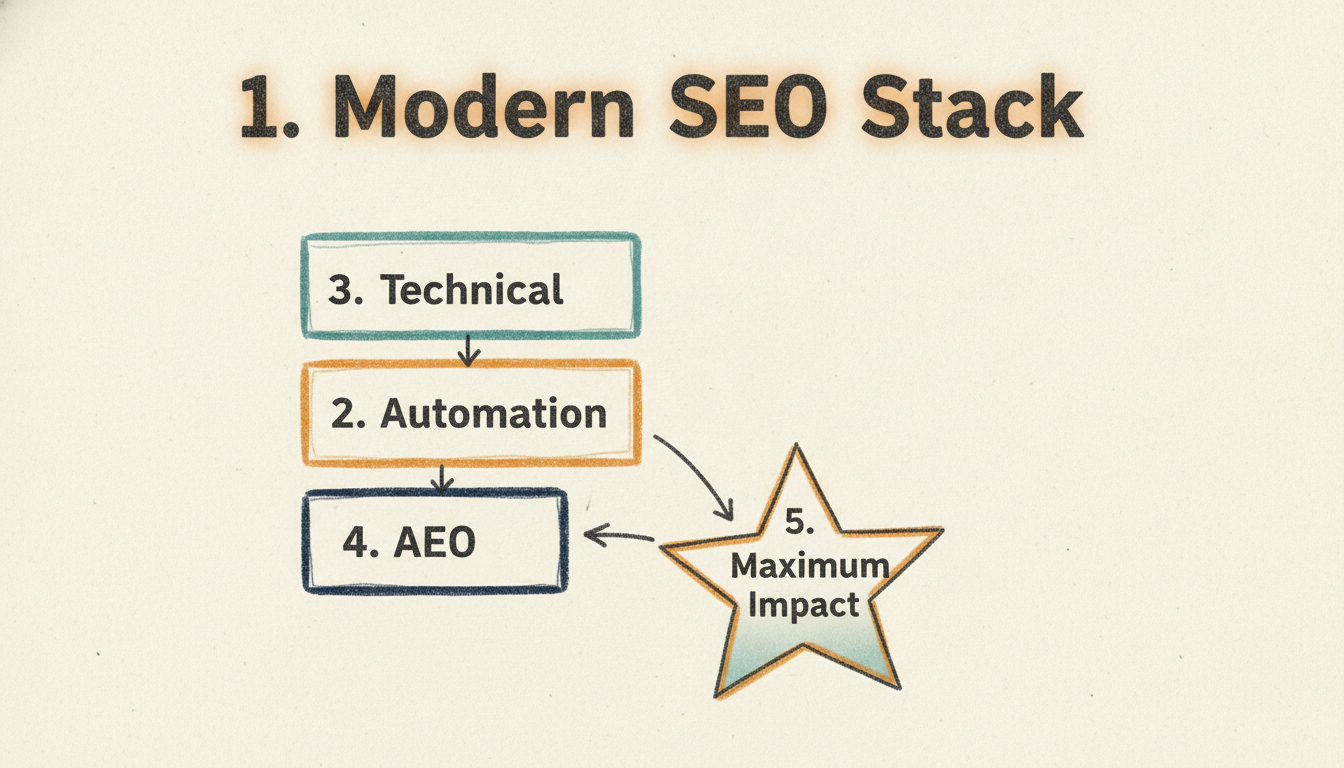
A single WordPress plugin rarely manages the entire SEO lifecycle in the current search environment. Most businesses now require a modular approach that addresses technical foundations, automated content production, and AI search visibility (AEO).
The Growth Stack is the most effective setup for startups and content creators. It pairs Tydal with Rank Math to handle both ends of the visibility spectrum. Tydal automates the keyword planning and publication process, allowing small teams to scale organic traffic without hiring dedicated writers. Rank Math then provides the technical tracking necessary to monitor how that content performs across Google and AI platforms like ChatGPT.
Performance purists often prefer the AEO Stack. This combination uses The SEO Framework for its lightweight technical foundation and RankReady for specialized AI search optimization. RankReady focuses on the AI search layer by generating llms.txt files and markdown endpoints, ensuring your site is citable by engines like Perplexity.
Avoid the common mistake of running two technical plugins, such as Yoast SEO and Rank Math, at the same time. These tools often attempt to manage the same schema and sitemap settings, which creates code conflicts and slows down server response times.
Prioritize tools that support markdown endpoints and structured data. AI crawlers increasingly ignore traditional HTML in favor of clean, machine-readable formats. A modern stack must bridge the gap between being found by a human on Google and being cited by an LLM in a chat interface.
Top 5 WordPress SEO Plugins: Features & Pricing Comparison
| Product Name | Best For | AI/AEO Features | Automation Level | Pricing (Starting) |
|---|---|---|---|---|
| Tydal | Growth Automation & Content Production | AI Visibility Optimization | High (Creation & Publication) | Contact for pricing |
| Rank Math | AI Search Traffic Tracking | Content AI & Gemini/ChatGPT tracking | Moderate (Technical & Content suggestions) | $7.99/month (Pro) |
| Yoast SEO | Brand Insights & Readability | Brand Insights & AI Content Planner | Moderate (Readability & Technical) | $99/year (Premium) |
| RankReady | AI Search Layer (AEO) Optimization | llms.txt & Markdown Endpoints | Low (Technical Layer) | Free Forever |
| The SEO Framework | Performance Purists | N/A | Low (Technical Foundation) | Free |
Choosing the Plugin That Removes Your Content Bottleneck
Modern WordPress SEO requires a shift in focus. The primary challenge for most sites is no longer technical configuration; it is the production of rankable content at scale. While traditional plugins excel at providing checklists and measuring technical health, they often leave the actual writing and publishing to the user. Selecting the right tool depends on where your workflow breaks down.
If your site struggles with server load or core web vitals, The SEO Framework provides a clean foundation without the bloat of larger competitors. For those who need to monitor how AI search engines like Perplexity or ChatGPT perceive their site, RankReady and Rank Math offer specialized tracking and technical endpoints. Yoast SEO remains a reliable choice for teams that prioritize readability and brand sentiment monitoring through its newer insights tools.
For startups and creators who lack a dedicated content team, the bottleneck is usually the manual labor of keyword research and writing. Tydal addresses this by automating the entire lifecycle from planning to publication. It is a strong option for those who need to increase organic traffic and visibility on both Google and AI platforms without adding more manual tasks to their daily schedule.
The best way to evaluate these tools is to look at your actual output over the last 30 days. If your technical SEO is perfect but your traffic is stagnant because you cannot publish enough content, a growth automation platform will offer more value than another technical checklist. Test these plugins based on how much time they return to your schedule rather than the number of green lights they provide in the dashboard.
Frequently Asked Questions
Which WordPress SEO plugin is best for beginners?
Yoast SEO is widely considered the best for beginners due to its intuitive traffic light system and readability analysis. It guides users through basic on-page optimization without requiring deep technical knowledge. Rank Math is also a strong contender but has a steeper learning curve because of its extensive feature set.
Can I use more than one SEO plugin on my WordPress site?
Running two full-featured technical SEO plugins like Yoast and Rank Math simultaneously is not recommended. Doing so often causes code conflicts, duplicate meta tags, and slower site performance. You can, however, pair a technical plugin with a specialized tool like RankReady for AI search optimization or Tydal for content automation.
How do I optimize my WordPress site for AI search engines like ChatGPT?
Optimizing for AI search involves providing machine-readable formats like markdown and maintaining an llms.txt file. Plugins like RankReady and Rank Math now offer features specifically designed to help AI crawlers index and cite your content. This shift from traditional SEO to AI Search Optimization is becoming a standard requirement for visibility in 2026.
Is Rank Math better than Yoast SEO in 2026?
The choice between Rank Math and Yoast SEO depends on your specific needs for tracking and performance. Rank Math offers a more generous free tier and was the first to integrate AI search traffic tracking directly into its dashboard. Yoast SEO remains the leader for brand sentiment monitoring and readability analysis, though many of its advanced AI features are behind a higher price point.
What is the fastest WordPress SEO plugin for site speed?
The SEO Framework is currently the fastest major SEO plugin with a server load impact of approximately 0.24ms. It is significantly lighter than Yoast SEO and Rank Math because it avoids built-in advertisements and unnecessary bloat. This makes it the preferred choice for developers and performance purists who prioritize Core Web Vitals.
How can I automate SEO content creation in WordPress?
Tydal is a growth automation platform that handles the entire lifecycle of SEO content from keyword planning to publication. Unlike traditional plugins that only provide checklists, Tydal generates and publishes articles to help businesses scale organic traffic without a dedicated content team. This approach solves the content production gap that manual tools cannot address.