6 Best Local SEO Companies & Platforms (2026 Guide)
Are you paying a $3,000 monthly retainer for work that an autonomous agent could handle in minutes? In 2026, the value of a local SEO company is no longer measured by how many citations they manually submit, but by how effectively they position your business within both Google Maps and generative AI search engines.
Evaluating a partner today involves looking past basic keyword rankings. You need to determine if your business requires high-touch strategic consulting or high-volume content execution. Traditional agencies excel at complex, multi-channel campaigns for established brands, but they often introduce a content burden where manual approvals and slow turnaround times stall growth. Automation-first platforms have emerged to solve this by handling the end-to-end lifecycle of keyword planning and publishing, specifically targeting visibility in AI platforms like ChatGPT and Perplexity.
The market is currently split between three distinct categories. First, there are full-service agencies that provide a dedicated account team and custom strategy. Second, there are specialized reputation management tools focused on Google Business Profile (GBP) health and review automation. Third, a new class of Generative Engine Optimization (GEO) platforms focuses on winning the AI search battlefield. Your choice depends on whether your bottleneck is technical profile management, local content production, or overall brand authority.
This guide breaks down the top performers based on their ability to drive local traffic in a post-AI search world. We compare the high-scale capabilities of traditional giants like Thrive and WebFX against the lean, automated workflows of Tydal and RadarKit. Use this list to identify where your current SEO strategy is failing, whether that is a lack of localized content or a profile that is invisible to modern AI search agents.
The 2026 Local SEO Landscape: Agencies vs. Automation
The search environment in 2026 is no longer defined solely by the Google Map Pack. Local discovery now happens across AI platforms like ChatGPT and Perplexity, requiring a shift toward Generative Engine Optimization (GEO). When choosing a local SEO company, the primary decision is between hiring a full-service agency or deploying an automation platform.
Traditional agencies like WebFX or Thrive provide a high-touch experience, handling everything from technical audits to multi-channel strategy. These services typically require retainers between $3,000 and $7,500 per month. Though effective for mid-market firms, the manual nature of agency workflows often creates a content burden. Startups frequently find themselves waiting weeks for content approvals or keyword research updates, which can stall organic growth in fast-moving niches.
Automation platforms offer a different path for businesses that need to scale visibility without the overhead of a content team. Tools like Tydal automate the end-to-end lifecycle by handling keyword planning, AI-driven writing, and direct publishing. This approach eliminates the need for a $1,500 monthly content retainer while ensuring your business is optimized for both traditional search and AI-driven discovery.
Choose an agency if you have a complex multi-location footprint and a budget exceeding $2,500 per month. Opt for automation if you are a creator or startup focused on rapid content production and organic lead generation without adding headcount.
1. Tydal: Best for Automated Content & AI Search Visibility

Tydal operates as an automated engine for businesses that need to scale their organic presence without the overhead of a traditional content department. It handles the repetitive cycle of identifying high-intent keywords, drafting articles, and pushing them live to your site. This makes it a practical choice for startups and creators who want to rank on Google and newer AI search platforms like ChatGPT without managing a team of writers.
The platform focuses on workflow efficiency. By automating the end-to-end SEO lifecycle, it removes the friction of manual research and the constant need for editorial oversight. You get a system that maintains a steady publishing cadence, ensuring your brand stays visible in both traditional search results and the generative answers provided by modern AI tools.
Best for Startups and Creators Needing Automated SEO Content
Tydal fits businesses that are scrappy by nature and need to generate traffic quickly without a $1,500 monthly agency retainer. It serves as a replacement for manual content workflows, allowing a single founder or a small team to compete with much larger organizations in the search rankings.
What stands out in actual use:
- End-to-End Automation: The system manages everything from the initial keyword strategy to the final publication on your website.
- AI Search Optimization: Content is structured to be picked up by generative engines like ChatGPT, which is a growing source of local and B2B discovery.
- Reduced Overhead: It eliminates the need to hire, train, and manage freelance writers or specialized SEO agencies for content production.
While Tydal is highly effective for content-driven growth, it is not a replacement for a full-service agency if you need manual citation building or complex technical site audits. It is also not the right fit for large enterprises that already have established content departments and strict, multi-layered approval processes. The platform is built for speed and autonomy, which might feel too hands-off for teams that want granular control over every single sentence.
Tydal is a specialized automation tool that bridges the gap between DIY SEO and expensive agency management, specifically for those prioritizing content volume and AI visibility.
The Shift Toward Generative Engine Optimization (GEO)
Traditional local SEO companies often focus exclusively on the Google Map Pack and directory listings. Tydal takes a different path by focusing on the content that AI models use to provide answers. In 2026, searchers are increasingly asking ChatGPT or Perplexity for local recommendations. Tydal helps ensure your business is part of that training data by publishing high-quality, relevant articles that these models can ingest and cite.
Where it Works Best in Your Workflow
I recommend using Tydal as your primary engine for top-of-funnel and middle-of-funnel content. If you find yourself spending more than five hours a week on keyword research or managing writers, the automation here provides immediate relief. A good rule is to let Tydal handle the bulk of your informative SEO posts while you focus your manual energy on high-conversion landing pages or specific product announcements.
2. BrightLocal
BrightLocal is a specialized platform for businesses that need to own the Google Local Pack. It provides a technical foundation for managing citations and monitoring local map rankings across multiple zip codes, making it a staple for agencies and multi-location brands that require granular data.
The platform excels at visualizing local search performance through its signature grid reports. This approach turns abstract SEO data into a clear map of visibility gaps, helping users identify exactly where they need more citations or better review velocity to beat local competitors in specific neighborhoods.
Best for local agencies and small businesses focused on Google Business Profile (GBP) dominance
This tool fits companies that prioritize the Map Pack over general organic results. It is particularly useful for service-based businesses where local proximity is the primary driver of leads and phone calls.
What stands out in actual use:
- Local AI Visibility Tracker: Monitors how emerging AI search tools and LLMs perceive your business information in the 2026 search environment.
- Citation Builder: Automates the submission of business data to key directories to ensure NAP (Name, Address, Phone) consistency.
- Visual Reporting: Generates white-label reports that illustrate ranking improvements over time for clients or internal stakeholders.
While BrightLocal is excellent for monitoring and reporting, it remains a passive tracking tool. It identifies ranking drops and citation errors but does not automatically generate and publish the SEO content needed to fix those issues. Users still need to manually write posts or use separate automation tools to execute the strategy. Additionally, advanced reputation management features are locked behind the more expensive Grow plan.
BrightLocal is a top-tier choice for data-driven local SEO management, offering the most granular map-based tracking currently available for single-location businesses starting at $41 per month.
3. Semrush Local: Automated Directory Syncing and Profile Management
Semrush Local is a specialized toolkit designed for businesses that need to maintain consistent data across dozens of online directories without manual data entry. It acts as a bridge between your core business information and the fragmented world of local search, ensuring your address, phone number, and hours are identical everywhere from Google to niche industry maps.
The platform shines for users who already rely on the broader Semrush ecosystem and want to bring their local presence under the same roof. By automating the distribution of listings and providing a centralized dashboard for review management, it removes the friction of logging into multiple platforms to update a single holiday schedule or response.
Best for multi-location brands requiring automated directory syncing and AI profile management
This tool is particularly effective for franchise owners or marketing managers overseeing several storefronts where manual updates are no longer feasible. It provides the scale needed to manage a growing footprint while maintaining the granular control required for local relevance.
What stands out in actual use:
- GBP AI Agent: This feature handles autonomous profile growth and posting, reducing the time spent on repetitive Google Business Profile updates.
- Listing Management: It pushes your business data to top global directories simultaneously to ensure NAP (Name, Address, Phone) consistency.
- Automated Review Replies: You can set up AI-powered responses to customer reviews, helping maintain engagement without manual oversight for every comment.
- Map Rank Tracker: This provides a visual grid of how your business ranks in specific geographic areas, making it easy to spot where competitors are gaining ground.
The primary tradeoff is the pricing model, which is calculated per location. For large franchises with hundreds of sites, the monthly cost scales quickly and can become a significant line item. Additionally, users must maintain a standard Semrush subscription to access the full suite of local tools, making it a better fit for those already invested in the broader software ecosystem.
Semrush Local serves as a powerful automation layer for businesses that have outgrown manual spreadsheets but are not yet ready for a full-service agency retainer.
4. RadarKit
RadarKit is a specialized tool for businesses that have moved beyond traditional search engine results and want to dominate AI-driven platforms. It operates as a dedicated AI SEO suite, focusing specifically on how your local business appears inside Generative Engine Optimization (GEO) environments like ChatGPT, Perplexity, and Gemini.
The platform uses hyper-local residential proxies to simulate real user queries from specific geographic coordinates. This allows you to see exactly how an AI model recommends your business to someone standing on a specific street corner. It provides a level of accuracy that standard rank trackers cannot match because it bypasses the generic data centers that AI models often flag or ignore, giving you a true view of the AI search battlefield.
Best for Generative Engine Optimization (GEO)
This tool is built for the 2026 search reality where customers ask "Where is the best coffee near me?" directly to an AI assistant. It fits tech-forward local brands and agencies that need to prove their visibility in non-traditional search interfaces and want to optimize for AI recommendations rather than just the Google Map Pack.
What stands out in actual use:
- Local Radar: Tracks business visibility across AI platforms using residential proxies to ensure data reflects actual local intent.
- Autonomous AI Agents: Deploys agents to handle complex query fanouts, which test multiple variations of a local search to see which keywords trigger your business as a top recommendation.
- Shopping and Ads Radar: Monitors how your products or services appear in AI-driven shopping assistants and experimental ad placements.
As a newer platform, RadarKit lacks the decades of historical data and massive backlink databases found in legacy SEO giants. The interface is designed for users who already understand GEO concepts, which can create a steep learning curve for those transitioning from traditional citation management. You will find that it is a highly technical tool that requires a clear strategy to use effectively.
RadarKit is a forward-looking choice for those who view AI search as the primary battlefield for local customer acquisition and need the specialized tools to win there.
5. WebFX: Best for Mid-Market Full-Service Management
WebFX is a heavy-hitting local seo company designed for mid-market businesses requiring comprehensive human management alongside proprietary technology. It functions as a full-service agency partner for companies with 250 to 999 employees, providing the scale and expertise required to manage complex, omnichannel marketing campaigns.
The core advantage lies in their closed-loop approach to reporting. While many agencies focus on metrics like impressions, WebFX uses its proprietary MarketingCloudFX stack to tie specific local SEO activities directly to bottom-line revenue and CRM data. This makes it a reliable choice for organizations that must justify every dollar of marketing spend to an executive team.
Best for mid-market companies with large budgets requiring full-service omnichannel management
This agency fits businesses that have outgrown DIY tools and now require a dedicated team to handle everything from call tracking to AI-assisted campaign optimization. It is particularly effective for those who want to integrate their local search presence with broader digital marketing efforts like paid search and email.
What stands out in actual use:
- MarketingCloudFX: This proprietary tech stack centralizes data from over 1,200 integrations, allowing for deep CRM and revenue attribution.
- LocalFX: A specialized tool within their suite that manages local listings and ensures data consistency across the web.
- Revenue Tracking: Features like RevenueCloudFX and call tracking provide a clear view of how local searches convert into actual sales.
- Industry Specialists: The agency maintains a massive scale with experts dedicated to specific niches, ensuring your strategy is informed by vertical-specific data.
The primary hurdle is the high barrier to entry. With pricing starting at $2,500 per month, WebFX is often out of reach for small startups or solo creators who might find better value in automated content platforms like Tydal. Their service model typically requires long-term contracts and a significant commitment of both time and capital, which lacks the flexibility of month-to-month software subscriptions.
WebFX is a premium, high-scale solution for established businesses that prioritize deep data integration and human-led strategy.
6. Thrive Internet Marketing Agency: High-Scale Full-Service Management
Thrive Internet Marketing Agency represents the traditional, high-touch approach to local SEO. It is designed for businesses that have the budget to outsource their entire strategy to a team of experts rather than managing a software stack themselves. The agency focuses on building a local presence through a mix of technical SEO, local citation management, and manual content strategy to ensure a stable search footprint.
Choosing an agency like Thrive provides a level of accountability and customized strategy that automated tools often lack. Their workflow centers on a weighted scoring methodology to ensure every local campaign meets specific performance benchmarks. This makes it a reliable choice for companies that need a comprehensive solution with proven historical data and a dedicated account manager to oversee the process.
Best for businesses seeking a high-rated, traditional full-service agency experience
This agency fits mid-market companies or established local businesses that need to scale rapidly across multiple regions. If your team lacks the time to oversee AI-generated content or manage directory syncing manually, Thrive provides the human oversight necessary to maintain brand consistency and handle complex local competitive landscapes.
What stands out in actual use:
- Weighted Performance Scoring: They use a specialized scoring system, often reaching 98/100, to track and validate the success of local search campaigns.
- Hybrid Optimization: The team combines manual strategy with AI-driven local optimization to stay competitive in the current search environment.
- Verified Results: Their track record includes documented growth for clients across diverse industries, from home services to professional B2B firms.
The primary drawback is the inherent friction of manual agency workflows. Because strategies require human review and approval, turnaround times are naturally slower than the instant execution offered by automation platforms. Additionally, the cost of service is significantly higher than software-only solutions, which might price out smaller startups or solo creators.
Thrive is a top-tier choice for those who value human expertise and a comprehensive agency relationship over the speed and low cost of pure automation.
Decision Matrix: Managed Agency vs. SEO Automation
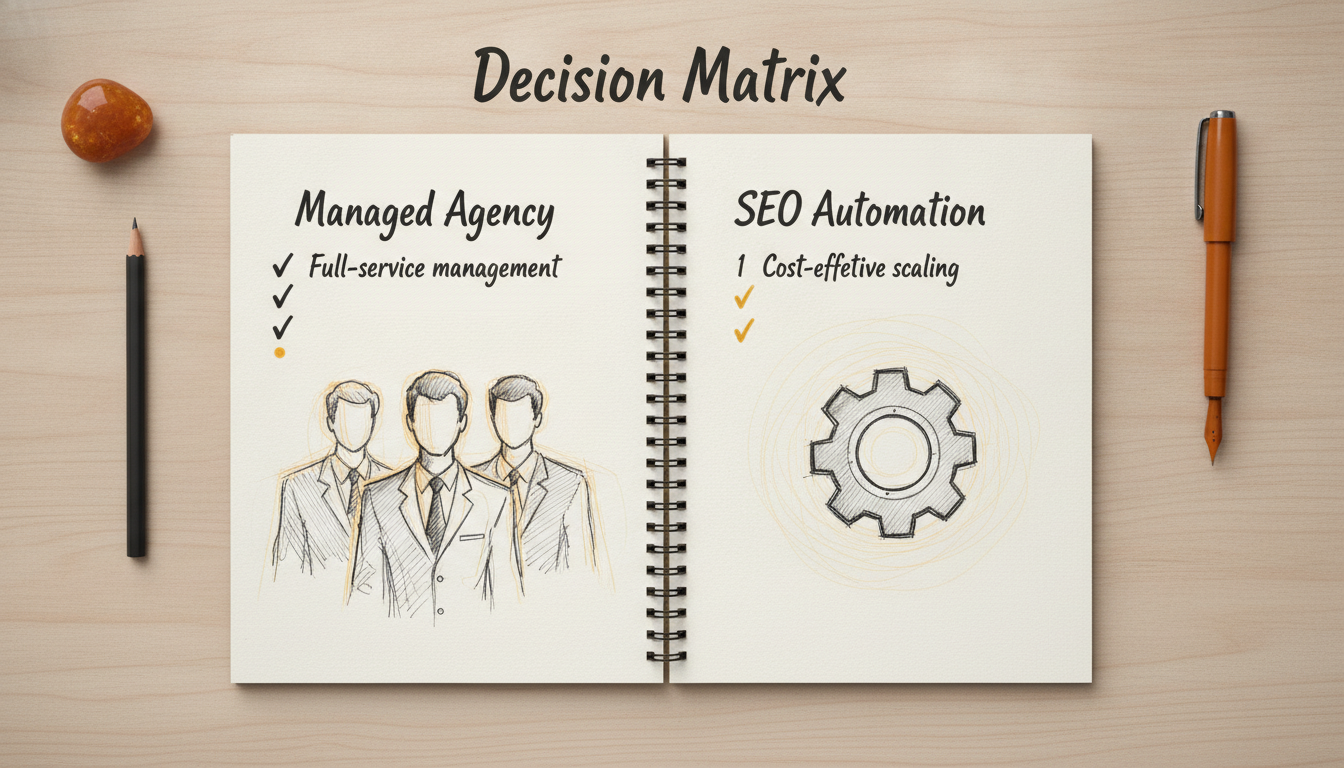
Choosing between a local SEO company and an automated platform depends on your growth stage and available bandwidth. Startups and content creators often hit a wall where manual content creation becomes the primary bottleneck for organic traffic. If your goal is to scale visibility on Google and AI search engines like ChatGPT without adding headcount, automation tools like Tydal provide a direct path. These platforms handle keyword planning and publishing for a fraction of the cost of a human team, making them the default choice for businesses that need high content volume without the overhead of a $1,500 monthly retainer.
A managed agency like WebFX or Thrive becomes the right choice when marketing needs expand into complex multi-channel strategies. These firms typically require a monthly budget of at least $2,500 and are best suited for mid-market companies that need deep CRM integration or offline conversion tracking. If you are managing a single location and want to maintain control, a hybrid approach often yields the best results. You can use BrightLocal to track citations and manage reviews while relying on automation to fuel your site's content engine.
The decision often comes down to the "Content Burden." If you spend ten hours a week reviewing agency drafts or struggling to find time to write blog posts, automation is the logical next step. It removes the friction of manual approvals and allows you to focus on running the business while the software maintains your search presence. Agencies are for when you want a partner to handle the strategy; automation is for when you want the work done at scale.
"Hiring a local seo company for basic data entry is a waste of budget that belongs in your ad spend."
Top 6 Local SEO Companies & Platforms: Features & Pricing Comparison
| Provider | Pricing (Monthly) | AI/GEO Capabilities | Best For | Primary Service Type |
|---|---|---|---|---|
| Tydal | Cost-effective alternative | Google and AI (ChatGPT) optimization | Startups and creators needing automated content | Automation Platform |
| BrightLocal | $41/mo (Track plan) | Local AI Visibility Tracker | GBP dominance and reputation management | Software Platform |
| Semrush Local | $30/mo to $60/mo per location | GBP AI Agent for autonomous profile growth | Multi-location brands and franchises | Software Platform |
| RadarKit | $29/mo to $139/mo | Hyper-local residential proxies for AI tracking | Businesses prioritizing AI search rankings | AI SEO Suite |
| WebFX | Starting at $2,500/month | MarketingCloudFX tech stack | Mid-market companies with large budgets | Full-Service Agency |
| Thrive Internet Marketing Agency | Not listed | AI-driven local optimization | High-scale growth and traditional agency needs | Full-Service Agency |
Choose the Local SEO Solution That Solves Your Content Bottleneck
Selecting a local seo company in 2026 requires looking past simple map rankings to address the actual workload of maintaining a digital presence. Most businesses fail at SEO because they cannot keep up with the constant demand for fresh, optimized content. If your primary struggle is the high cost of agency retainers or the slow turnaround of manual approvals, an automation-first approach is often more effective than a traditional service model. High-end agencies like WebFX or Thrive Internet Marketing Agency provide comprehensive, white-glove management that fits mid-market companies with budgets exceeding $2,500 per month. These firms are ideal when you need deep CRM integration and a dedicated team to handle omnichannel strategy.
For businesses that prefer to keep management in-house, tools like BrightLocal and Semrush Local offer the best infrastructure for Google Business Profile management and citation syncing. These platforms excel at maintaining data consistency across the web and tracking how your business appears in local map packs. If your strategy is shifting toward Generative Engine Optimization (GEO), RadarKit provides specialized tracking for how AI models like Perplexity and Gemini perceive your brand. Each of these tools serves a specific operational need, whether it is directory accuracy, high-level strategy, or AI-specific visibility.
Startups and content creators often face a different challenge: the need for organic growth without the budget for a full content team or a $5,000 monthly agency retainer. Tydal fits this specific gap by automating the entire SEO lifecycle. It handles keyword planning, writes the content, and publishes it directly to your site. This allows small teams to compete with larger competitors by maintaining a high volume of search-optimized articles that rank on both Google and AI platforms like ChatGPT. It is a practical choice for those who want to increase traffic while reducing their manual workload.
Before committing to a long-term contract, I recommend testing these solutions based on their actual output rather than their marketing promises. Request a sample of the AI-driven content or a trial of the visibility tracking to see if the data aligns with your local market reality. The right choice should feel like a relief to your daily operations, not another complex tool that requires a new hire to manage. Starting with an automated platform like Tydal can help you build a foundation of organic traffic quickly, allowing you to scale into more manual agency services as your revenue grows.
Frequently Asked Questions
How much does a local SEO company cost in 2026?
Most US agencies charge between $3,000 and $7,500 per month for full-service local SEO management. Smaller software-based solutions or automated platforms are significantly more affordable, often ranging from $30 to $150 per month. The total cost usually depends on the number of business locations and the volume of content required.
What services do local SEO companies typically provide?
These companies manage Google Business Profiles, build local citations, and optimize website content for geographic keywords. Modern providers also focus on reputation management and Generative Engine Optimization to ensure visibility in AI search tools. Some agencies offer manual strategic consulting while others provide automated tools for content execution.
How do I choose the best local SEO company for my small business?
You should evaluate a provider based on their ability to solve your specific bottleneck, such as a lack of localized content or technical profile errors. Startups and creators often benefit from automated platforms like Tydal, which handle keyword planning and publishing without the high cost of a manual agency team. Always look for transparent pricing and verified client results before signing a contract.
Is local SEO still effective with the rise of AI search engines?
Local SEO remains highly effective but now requires a focus on how AI models like ChatGPT and Perplexity perceive your business. Modern strategies involve optimizing for both traditional map packs and generative engine results to capture traffic from all search types. Ensuring your business data is accurate across directories remains the foundation of these efforts.
How long does it take to see results from a local SEO service?
Most businesses begin to see measurable improvements in local rankings and organic traffic within three to six months. The exact timeline varies based on local competition, the current state of your website, and how frequently you publish new content. Consistent activity, such as regular profile updates and review management, typically leads to faster results.